Saturday, June 5, 2010

Hall! Office! Zero!


I was still young, albeit by most standards—with the exception of older brothers and sisters who for some reason thought they should be able to tell me what I could do by virtue of being the youngest of seven children—over 25 years-old and with a family of five or six of us. I lose count. (Shown to the right are my wife, Sheila, my parents, Ellis and Lola and four of our children in 1972. L-R Beth, Sheri, and Julie and in my ever-loving arms, Sam, Jr.)
It should be noted that my favorite comeback to my elder siblings was, “I put the grits on my table; I’ll make the decision, sans your advice.”
I was about to embark on a college career thanks to the GI Bill for veterans. At the time, we were living in Warner Robins. I decided to attend Middle Georgia College and to seek a degree in Business Administration. I arrived at the college and went to the assigned testing area to take my College Entrance exam. There were quite a few people, mostly freshly graduated from high school and one or two my age or in that vicinity.
I could not believe it when I looked up to the front of the room and spotted a very familiar face, one I had not seen perhaps since my days in high school.
My mind immediately drifted back some ten or twelve years and into my high school math class. As the teacher scanned the role, she called out the names of my classmates and she paused only slightly when she came to one name. She called out my name with an edge of bitterness to it. “Crenshaw!” To my credit, I answered promptly with either a here or present which seemed to rankle her. Was it just my imagination or did she growl slightly?
Well, the answer came instantly! She did growl! “Mister, I had your brother in my class for two years, and you can just forget acting like him. Do you understand me? He didn’t get away with it and neither will you! Are we clear? Do you understand me?” she asked without leaving room for an answer. (Sam at age 17 looking truly innocent, don't you agree)
That was the beginning of a tumultuous couple of years in which her weapon was bullying me and others whom she had reason to suspect she needed to bully. I should explain that the nature of a “brilliant teenager” is one in which he seeks an opening for a laughter-induced remark. Inevitably, it probably wasn’t worth it, because she would pullout her grade book and say, that’s it! You get a zero!
In time, she put up with any rebellion even less and shortened it to something that I recall as, “Hup! Hup! Hall! Office! Zero!” while folding her arms across her ample bosom and pointing toward the door. As the man said when the Hindenburg crashed and burned, “Oh the humanity of it!”
Somehow, I managed a C+ for my four years of high school, but when I looked at the familiar face supervising the College Entrance Exam, I shook with humiliation and fear from my strange high school days. There is little doubt that she had looked over the last of names of those of us who were scheduled to take the test, because, when I raised my hand in an attempt to ask where I should put my name on the test sheet, she flew into a rage and went directly into her past life.
“No sir! Not in here, Mister! This is college! You will not be allowed to disrupt this test!”
“I just want to know where----.” She cut me off and looked around the room at all of the nervous little kids from high school for their approval of how she had just handled her former student.
I raised the white flag of surrender and just printed my name on the paper where I thought it should go.
Oh the trauma I suffered!
Purchase my book "Stories From the Cotton Patch" by ordering from Sam Crenshaw, 966 Barlow Road, Hawkinsville, GA 31036. $10 plus $3 S & H.

Wednesday, May 12, 2010

Something’s Happening Here


The musical group, Buffalo Springfield recorded a song that started as follows:
There's something happening here,
What it is ain't exactly clear.
There's a man with a gun over there,
Telling me I got to beware.
Quite frankly, I never paid a lot of attention to it, however in today’s world, I suggest that we may need to take heed to what’s happening here and now.
There are too many troublesome things that are happening that may change our lives and the lives of our children and grandchildren as well.

At the beginning of World War II, President Franklin D. Roosevelt did his dead-level best to keep us neutral and out of the horrendous things that were happening in Europe and in the Pacific. The old hide your head in the sand and hope it will go away syndrome. Then Pearl Harbor was attacked brutally and mercilessly by the Empire of Japan one early Sunday morning in one of the deadliest sneak attacks in history.
America declared war on Japan! History records that the horrible act drug us into World War II, followed immediately by Hitler’s Nazi Regime declaring war on us. We were in that war less than a quarter century after the end of World War I which had brought Germany to its knees. Men left farms, jobs and families as they enlisted and were drafted into branches of the military to battle enemies on both continents. Before it ended in 1945, over 3,000,000 lives were sacrificed for the effort to bring America to the forefront as the greatest power in the world. Once again, Germany was shattered in defeat—Adolph Hitler was dead of suicide, but it would take more than that to defeat the tyrannical Japanese military which had inflicted the horrors of death and punishment upon the POWs who were captured. Japan was withdrawing to their homeland and declared to fight to the last warrior.
President Harry S Truman made that impossible when he unleashed two atomic bombs—the world’s first weapons of mass destruction—on major cities of the land of the rising sun. Then, and only then did the Japanese quit. Power made them do so.
Today, our nation has elected a man, half-White and half Black who says he is Black and many people were proud that this nation had shown that kind of greatness to elect for the first time in history, a man of color.
He campaigned brilliantly on “hope and change” and he was elected in a landslide over former POW, Senator John McCain. To say that Barack Obama was vague in his pledges would be an understatement. After a little over a year, the President and a majority of Democratic Congressmen and Senators have shown there is little doubt that the change part is for real.
If you think for one minute that it is over, you had better think again.
The Health Bill that was rammed through Congress and signed into law by Mister Obama is being challenged by many, but he has clearly stated that it will not be repealed, even if the Republican Party takes back the majority in either the House and/or Senate, because he will veto such an effort as long as he is in office. There is a clear majority of Americans who feel the bill should not have been passed and will turn our medical care and facilities into a form of socialism.
A great number of people have formed a movement called The Tea Party with protests against the Health bill as well as other items on the agenda. A brand new survey indicates that only 22% of the American people trust our government. That is a sad state of affairs.
Many feathers have been ruffled by the words of President Obama as he has gone around to other countries stating that America is an arrogant nation and offered apologies for this nation’s behavior. He has on his agenda an effort to eliminate nuclear weapons from the world. To say that would be a lofty goal, recalling the words of our enemies around the world who have been extremely vocal about destroying our nation’s freedom and liberty.

It is not just about the brutal attack of September 11, 2001 when four planes were hijacked and used as weapons to destroy the Twin towers of the World Trade Center and an open attack against the Pentagon both—including the fourth plane where all lives were taken in a crash in a field over the Pennsylvania countryside—resulting in thousands of innocent lives being destroyed. No!


This open attack on our nation has been underway for many years by the radical Muslim extremists. Remember the Muslim bombing of Pan Am Flight 103 over Lockerbie, Scotland! Remember the Muslim bombing of the World Trade Center in 1993! Remember the Muslim bombing of the Marine Barracks in Lebanon! Remember the Muslim bombing of the Military Barracks in Saudi Arabia! Remember the Muslim bombing of the American Embassies in Africa! Remember the Muslim bombing of the USS Cole!
Destroying our nuclear advantage by giving up our arsenal which is the only thing that keeps us safe against the despots who wish to destroy our way of living is akin to the many successful attempts to disarm Americans, taking away our Second Amendment rights of the Constitution. Don’t ever forget the adage of when they take our guns away, only the bad guys will have guns. History is rife with examples of this.
In 1929, the Soviet Union established gun control. From 1929 to 1953, about 20 million dissidents, unable to defend themselves, were rounded up and exterminated.
In 1911, Turkey established gun control. From 1915 to 1917, 1.5 million Armenians, unable to defend themselves, were rounded up and exterminated.
Germany established gun control in 1938 and from 1939 to 1945, a total of 13 million Jews and others who were unable to defend themselves were rounded up and exterminated.
China established gun control in 1935. From 1948 to 1952, 20 million political dissidents, unable to defend themselves, were rounded up and exterminated. Guatemala established gun control in 1964. From 1964 to 1981, 100,000 Mayan Indians, unable to defend themselves, were rounded up and exterminated.
Uganda established gun control in 1970. From 1971 to 1979, 300,000 Christians, unable to defend themselves, were rounded up and exterminated.
Cambodia established gun control in 1956. From 1975 to 1977, one million educated people, unable to defend themselves, were rounded up and exterminated.
Defenseless people that have been rounded up and exterminated in the 20th Century because of gun control number in excess of 56 million. I am a firm believer in the Second Amendment and I fall into the category who use the line so elegantly put by the late Charlton Heston when he said, “From my cold dead hands!”
Some time ago, Newt Gingrich, former Speaker of the House said, “In the future he plans to speak out publicly about the need to recognize that America is in World War III.
He lists wars in Afghanistan, Iraq, bomb attacks in India, Iran and North Korean nuclear threats, terrorist arrests and investigations in Florida, Canada and Britain, and violence in Israel and Lebanon as evidence of World War III. He said. “We need to connect all the dots for Americans.”
He said the reluctance to put those pieces together and see one global conflict is hurting America’s interests. He said people, including some who urge a restrained response from Israel are wrong, “because they haven’t crossed the bridge of realizing this is a war.”
“This is World War III,” Gingrich said. And once that’s accepted, he said calls for restraint would fall away.
According to a report by the Associated Press, President Barack Obama snapped back at Sarah Palin and her criticisms about his nuclear defense policy, calling the former Alaska governor “not much of an expert on nuclear issues.”

Obama's comments came when asked for a response about a Palin critique that “he was like a kid poised for a playground fight who said ‘Go ahead, punch me in the face and I'm not going to retaliate. Go ahead and do what you want to with me.”
“I really have no response,” Obama told ABC News. “Because last I checked, Sarah Palin’s not much of an expert on nuclear issues.”
The interview occurred in Prague, where Obama signed a treaty with Russian President Dmitry Medvedev that orders both nations to shrink their nuclear arsenals. That deal that must still be ratified by the Russian Parliament and the U.S. Senate.
Palin was referring to another development on the nuclear front this week, a rewriting of American nuclear strategy.
Among many other elements of that new plan, the U.S. makes plain that if a non-nuclear nation is in compliance with an international non-proliferation treaty, the United States will not threaten or use nuclear weapons against it.
If such a state were to use chemical or biological weapons against the U.S. or its allies, it would face a potentially devastating conventional military strike by the U.S., but not a nuclear one.

Tuesday, March 30, 2010

For the Love of a River

A couple of years ago, Publisher Chuck Southerland of the Hawkinsville Dispatch & News had a vision to bring an Oral History Forum of the Ocmulgee River—a main portion of a living history of Pulaski County—to the historic stage of the Old Opera House.
His idea was to have citizens of our community, who had different perspectives, talk about how the muddy river has been a huge part of Hawkinsville and Pulaski County.
The public was invited to hear first-hand accounts of how the river has played a role in various parts of our lives.
First on the agenda, was eighty-two-year-old Sam Way III, a historian extraordinaire, of no small amount of knowledge concerning the history of the river and our county. Way pointed out that the development of history follows the rivers and trails of the world. When the European settlers came to the shores of this new land on the southeastern coast of what is today the United States of America, they found tribes of Indians living on the coastal plains. As more and more Europeans came ashore, they began to push the tribes inland. The Indians followed the Ogeechee River first and as they were forced to move on, they took to the Oconee River and finally to the Ocmulgee River. (Dedication of Bridge across the Ocmulgee River in 1917 drew a large crowd.)


They settled in this area and finally the Europeans came here as well, forcing the natives further west onto what we know today as the Flint River.
Just east of the Ocmulgee River, a small settlement was named Hartford, and because of the river and the ability to cross it where some rocks made it easy to do so, coupled with this area being a heavy cotton producing region, the small community began to become of great consequence. As Way told us in his talk that day, transportation was practically all by river, and the Ocmulgee following northward to Macon helped our area become even more significant in the trade and supplies which were a result of river travel.
Today, people can drive right through tiny Hartford, the area which at one time was a border town, and as a matter of history, it was one of the communities which were nominated to become the State Capitol of Georgia—losing by one vote as history has recorded it. The area along the banks of the Ocmulgee River connected by rocks was later named the Uchee Trail after the Indian tribes who lived here and finally to the Flint River where it ended in Macon County.
Again, keeping in mind that rivers and trails developed the history of the world, it is important to know that other trails came through our area.
The second trail was known as the DeSoto Trail discovered and named for the Spanish explorer, Hernando DeSoto who was looking for gold. After exploring through Florida, he later became famous for discovering the Mississippi River.
The third trail was known as Slosheye and it traversed to Vienna, a city which has become famous for its cotton production and its barbecue contest annually known as the Big Pig Jig which brings in folks from across the country to compete.


The fourth trail was named after Jefferson Davis the President of the Confederate States of America.
It was named after the political leader because he was making a desperate attempt to escape the Union forces which were hot on his trail. He was finally captured on the morning of May 10, 1865 in Irwin County in the small community of Irwinville. Speculation is that he may have spent one of his final nights of freedom in Pulaski County near the Ocmulgee River.
The fifth trail was named for the Chickasaw Indians. That trail runs from nearby Empire through Hartford, and is known today as the Chicken Road. Those trails along with the remarkable muddy river we know as the Ocmulgee were important in bringing five railroad lines into Hawkinsville during those historic times.
They were the Macon-Hawkinsville RR, the WT RR from Sandersville through Dublin to Hartford where it turned around and headed back eastward. The Hawkinsville and Florida Southern RR left here and headed south to Pineview-Pitts-Cordele and on down to Ashburn. The Hawkinsville & Western RR came in our direction from Browndale, and lastly, the Ocilla Southern RR came in from Irwin County and then left Hawkinsville en route to Fort Valley. Today, a railroad track is difficult to find in Pulaski County, most having been paved over.
John Calvin Hadden, Jr. a son of the last Riverboat Captain—who captained stern-wheeler steamboats up and down the Ocmulgee River—remembered the story of his father waving to a young woman who was fishing on the banks of the river, and she waving back in turn. The couple finally met and later married.
Around 1958, a group of men, approximately 200 plus, formed a charter of boat owners and some of the most fast-paced and exciting times ever took place on the muddy river as the boat club members raced for trophies to the enjoyment of many citizens who were celebrating the sesquicentennial of Pulaski County. Some of those who took part, other than Hadden, included Emmett Head, Ed Darsey and Mark Hall. How many people cross the bridges over the Ocmulgee River today without even a glance? There is much history in our muddy river! Some men such as Thomas Herrington and the late George Slappey taught their sons (George Slappey, DDS Retired, below) the value and enjoyment of fishing and hunting from the banks of the river.


Others like my brothers and I enjoyed the river of our youth while we were growing up within a stone’s throw of a splash. Most of us who have been on the river have tried our hand at water skiing at one time or another as did my old friend, Wendell Greer, grandson of Railroad Station Master, J. K. Greer.

On one occasion, with me pulling Wendell, my daredevil buddy spotted a water moccasin swimming across the river, but instead of trying to avoid him, he directed his skis on top of the deadly snake. Brave or crazy! Your guess is as good as mine! He enjoyed pulling me past where the sewer used to flow into the river and make a quick turn forcing me to sink right in there. Maybe he was just crazy.
This article would be incomplete without mentioning two things: floods and people who drowned. In 1994, we saw the river at its all-time recorded high when a good portion of old Hartford was underwater.
Through the years, quite a number of people have drowned in the Ocmulgee River because of a lack of respect for the swirling sink holes in it. If you want to hear first-hand knowledge of the danger that can lurk in our river ask Ed Darsey, a man who literally grew up swimming and fishing in the muddy waters and he has a true love of the Ocmulgee River.

Wednesday, March 10, 2010

Adventures in Camping

We began camping in 1968—wow! That is over forty years ago—when we rented a pop-up camper and headed west, as in Wyoming, Utah, New Mexico, Colorado, and Texas. At that time, we had never so much as put up a pup tent, nor had we ever cooked outside the confines of our kitchen.
To make it interesting, we planned the trip with my brother, Billy, whose family lives in Florida. They made the first leg of the journey to our home in middle Georgia. We spent the night in our house placing pallets everywhere to accommodate them and their five children and ourselves and our four children. Did I say they also were camping virgins.
We spread maps which we had acquired from AAA in Macon, and the debate was on about which route we should take. We felt confident—with strength in numbers—that we were up to the task. The plan was to get an early start and to make it as far as possible the first day, thereby gauging the length of time it would take us to get out west. What is the old saying about, “the best laid plans of men and mice,” or something like that. My memory is vague at this time as to why we were delayed in our effort for an early start, but a good guess would be that the women-folks probably had to stop at the grocery store.
Once on the road with the wind in our face and the miles spilling out behind us, we made good time, I think? Let’s see now. It is approximately 115 miles to Phenix City, Alabama, our first stop on the journey west. Where is my calculator? At this rate, we would need several weeks to reach Texas.


Actually, we made much better time the second day, arriving at a very crowded state park in Missouri. We were excited as we set up our campsites for the night. Everything was fine until the storm hit in buckets of rain.
How were the kids supposed to know the canvas covering on the camper would leak if they touched it? It was a very wet night, and everything was thoroughly soaked.
Alas! Better days were ahead as we decided to push the envelope by driving through the night. Ahh! To be young, and full of adventure. By the time we stopped in the foothills of Colorado, which seemed like mountains to us, we decided to make camp. How were we supposed to know that pancake batter would bubble up in the thin air of the high peaks, and how were we supposed to know that our Coleman stove would not light because of the thin air? Petty obstacles! A sure cure for that is Vienna Sausages. The thin air did not stop us from opening the cans.


We learned much from our two-week journey west, and we loved the adventure of it—seeing places we would not have seen otherwise. After our return home we began looking for our own camper to purchase, and became avid campers for the next three decades. Our children have so many memories—that money can’t buy—of those years.
Family values can be strengthened by the adventures of camping. Put it to the test, and enjoy the great outdoors!

Thursday, February 18, 2010

Dirt Roads and Two-lanes

So many things have happened to the world which we knew throughout our youth. Occasionally, I receive e-mails from folks who have dug up Burma Shave signs somewhere in cyberspace and think I would like to see them.
Well, I do! Growing up in the city by the muddy river, I never dreamed there were other worlds outside the realms of our tiny community. For instance, a rare trip to Atlanta found my school class going to the Capitol to see, shake hands with, and receive an autographed picture from Governor Herman Talmadge.

I think I was thrilled, but not overwhelmed by it. I much more enjoyed my first trip to the world famous Cyclorama, a hand painted wonder of the Battle of Atlanta. It looked so real, and I was struck by the manner in which the artists were able to blend in real clay with the heavy oil painting. For certain, it was like being there during the battle. In those days of my youth, they even put in a portion of the Cyclorama that was taken from the movie classic, “Gone with the Wind.” To my youthful mind, it seemed natural that part of the classical painting should be from the immortal film.
There was no Six Flags over Georgia nor the World of Coca Cola or other things which people go the “Big A” to visit today. Oh sure, there was a Stone Mountain, but back then there was nothing but the huge granite rock—no Laser Show.

In other words, a trip to Atlanta was basically a long drive into another world.
There were no Interstate highways, and to be sure there was not nearly the traffic jams known by any visitors to Atlanta today.
On the trek to Atlanta it seemed to take all day long on a trip up and back in one day. Of course we were young and there were games to make the trip more enjoyable. Does anyone besides me remember Cow Poker, counting cows, old gray mules lone-standing chimneys and of course having all the points erased if a cemetery should appear on your side of the road?
In those days, we used to entertain ourselves with counting the B. Lloyd Pecans signs on the curvy road through Roberta, Barnesville and Griffin. Another group of restaurant signs belonged to Stuckey’s Candy, a great place to take a break from the laborious trip.
To be sure, there were no McDonalds, Wendy’s or Burger Kings to stop for lunch. There was a Krystal here and there, and yes the small square burgers—more bun than burger—cost only nine cents each, but we may have only had a dollar for the entire trip. A dollar was not easy to come by. No one had come up with something called an allowance, at least at our house.
Regardless of our feelings for the day long journey in those days, they seem to remind me of the pre-Interstate highway days when roads were two-lane and side roads were mostly dirt. Associated with those kinds of roads today are some classical and historical towns at the end of them. But take caution, and run, don’t walk because even the most wonderful places in our beloved state are fast going the way of the modern era.
Nothing is sacred wherein developers and builders are concerned. In the 1970s prior to my mother’s death, we took her to the North Georgia Mountains and to the quaint, little Swiss Village of Helen, Georgia prior to the population explosion.
We could actually walk around without bumping or being bumped as we sampled their cheese and crackers and other goodies. It was a treat for my mother which I will never forget. A basic non-traveler, she thirsted for, and drank in the scenery of the pristine mountains of forty years ago. My last trip to Helen involved a traffic jam and a very slow trip through a basically noisy place for the younger set to drink, laugh and talk loud at modern-looking bars and taverns.
If you have never been across Blood Mountain, you should experience it once in your lifetime. It is better than a roller coaster of any magnitude. Even in the mountains which can become too crowded in the Fall of the year, there are still some two-lane roads which have escaped the widening of those very roads by the heavy caterpillars and cranes which are taking them away from we the people.
Many of us talk about the sadness, lack of security, and terrible condition of the world situation which turns us away from traveling abroad to see the wonders of the earth, but most of us have yet to see the wonders of America and what this land of plenty has to offer.
Even more so, most of us live a life too involved in speed and crowded four lane and Interstate roads. We’re in too big a hurry to get where we think we want to be to get out and drive on dirt roads or take two lanes to small towns such as Ideal, Byromville, Ty Ty, Claxton, Parrot, Attapulgus, Cherry Log, Elberton, Hiawassee, Sylvania, Eatonton, Haddock, Jesup, Talking Rock, Buena Vista, and those places are just a few of the small, historic towns which have so much to offer. Even the wacky things in some towns such as Warwick, self-named “The Grits Capitol of the World” where people make, eat and enjoy the southern staple.
They even have a contest wherein people get into a huge vat full of grits with overalls and are given a few minutes to load up with wet freshly-cooked grits—pockets, sleeves, trousers, ears, and hair—to see who weighs the most additional pounds after a pre-weight has been recorded—all in fun of course.
The good thing about visiting these small treasure-troves of small towns, attainable by two-lane and dirt roads, is they are terrorist-free.
Enjoy Georgia first!

Monday, January 25, 2010

Barber Shops, Now and Then

One morning, I stopped in for a visit at Larry Hedden’s barbershop. In my mind, I was immediately taken into another place and time, both fictional, and known to most of us as Floyd’s Barbershop in Mayberry.
Hedden was sitting in one barber’s chair, the other was occupied by Ernest Mashburn.
The only other person in the shop was John Coley, also sitting, but in a regular chair. It may as well have been Floyd, Gomer and Barney passing the time away. There was no urgency to the situation. I got the feeling that world problems had been discussed, if not totally solved. I was greeted amicably, offered a trim, but not a shave, or to take a chair and join the conversation. The shoe shine stand, once an integral part of the barbershop now stands vacant. “Do you even offer shaves anymore?” inquired Mashburn.
“No!” said Hedden. “No one asks for a shave anymore.” According to Google on the Internet, at one time there were 8000 barbers in the state of Iowa, however there are less than half that number of licensed barbers in the mid-western state today. Up until World War II, the shave was the main stay of barbershops, that is until the safety and electric razor took over. In the early 1950’s, short hair cuts such as the butch and the flat tops became popular, causing the barber trade to flourish.
In an earlier period of time, the old phrase, “Shave and a hair cut, two bits” became a favorite saying, and later after the war one could get a hair cut for 25c and a shave for 10c. When Elvis Presley became famous, sporting longer locks, the barbers really began to suffer for a lack of business. This was followed by the much longer hair style of the Beatles and others of the invasion of the British style of music, causing fewer barbershops, and a lot less barbers staying in the business.
Haircuts began to soar to a few dollars, and shaves only slightly less. Shops began to close, however in the city by the Ocmulgee River, one could still find a choice of barbershops and barbers, even during the turbulent sixties of hippies and long hair.
Some of the names synonymous with barbering through the years in Hawkinsville have been Southerland, Smith, Horne, Owen and Rewis. Mister Owen cut hair in the country on nhis farm. His son, Greg Owen, an antique collector has restored his father's barber shop as a sall museum.


For the longevity of barbering however, one name stood out more than any other. Her name is Elizabeth “Lizzie” Roland, four-time widowed barber, who lived to nearly a hundred-years-old. She was known as Mrs. Evans when she took over the barbershop from her deceased husband, Jim. Next, she married Terrell Wammock who cut hair part-time and repaired bicycles in the rear of the barbershop. Sometime after his death, she married Van Ellis from nearby Cochran. Widowed once more, the diminutive barber married another resident from Cochran named J. T. Roland. When one lives to become nearly a centenarian, one can expect to outlive most mates.
The very resilient barber began cutting hair in the late 1930’s and cut consecutively until she was 93, when she retired. In 1965, she was joined by a young barber who cut hair in her shop for five years. That barber was Larry Hedden.
There were three Southerland brothers who cut hair in Hawkinsville at the same time, although not always in the same barbershop. Charlie, also known as “Big Charlie,” his brother, J. B. known better as “Bud,” and Willie. After the death of his brothers, Bud Southerland and Dewey Horne went into business together, later electing to go their separate ways. Horne set up shop near, what today is known as the 341 Bypass next door to his home. Southerland stayed in the downtown section of Hawkinsville. That business, today, is Hedden’s Barbershop.
At one time, there were two barbers who were cousins, Sidney Smith and J. M. Smith. Each had their own shops, and each employed Southerlands in their business. Charlie and his brother, Willie worked for J. M. Smith, and Bud worked for Sidney Smith.
“One of the most asked questions about barbering,” said Hedden, “is where did the barber’s pole originate?”


To understand the answer to this question, one has to go back into the history of barbering. Again, according to the web site, Google, during the Middle Ages, if you were in need of surgery, you would require a trip to a barber-surgeon. Doctors were expensive and many did not practice surgery because it was regarded as a menial task. Self-help methods were not an option due to the scarcity of sharp tools.
Barber-surgeons used razors, not just to perform operations, but also to cut hair and shave beards. they also extracted teeth, lanced boils, set fractures and let blood. Unlike doctors, barber-surgeons usually had no medical training, and they dealt only with external problems. In 1540, the Company of Barber-Surgeons was created in an attempt to make training and treatment standard.
Barber-surgeons' shops were usually in the center of towns and attracted customers by displaying a red and white striped pole outside their shop. The colors stood for blood and bandages; these poles can still be found outside some barbershops today. In those days, if the city authorities allowed them to do so, some barbers would display a basin of blood outside to signify bloodletting.
Barber-surgeons continued to practice until the mid-18th century. In 1745 in London the Company of Surgeons was set up, and barbers were excluded; in 1800 it became the Royal College of Surgeons. However, many barbers retained the red and white pole outside their shops and continued to practice simple operations.
“Today,” said Hedden, “I only give a good hair cut when they sit in my chair.”

Friday, January 8, 2010

Before NASCAR

Half-Mile Dirt Tracks

NOTE: For those interested in where we stayed on Maui CLICK here for details www.mauiyes.com and get ready for a vacation in paradise


VA-ROOM! VA-ROOM! Pow, Pow, Pop! VA-ROOM! VA-ROOM! The flat-head engines of the 1936 Fords were sounding off as they warmed up for the race. In the late 1940s, a group of men got together and converted the famous horse racing track in Hawkinsville to a dirt track for stock car racing. It was a forerunner to what is known today as NASCAR, a billion dollar industry. In today’s version of NASCAR, names such as Jeff Gordon, Mark Martin, Bobby LaBonte, and Dale Ernhardt, Junior are some of the darlings of racing fans around the country.
Long before them came names like Jessie James Taylor, Nero Stepto, Wild Bill Bennett, Ross Howard, and the twin package from Hawkinsville, Billy “Buzz” Sawyer and one of the best racing mechanics to ever turn a wrench, Paul McDuffie shown below.

The night when stock car racing began in Hawkinsville at the old harness racing track, it attracted a near capacity crowd. According to the records, there were fifteen drivers participating in the races that night with a total of sixty laps around the half-mile dirt track.


The competition was fierce in every race, yet there were no injuries. One car, driven by Ed Tyndell of Unadilla, blew a front tire causing his vehicle to veer out of control. Momentarily, he was shaken up, but returned shortly to finish the race. Sawyer, a gritty and determined competitor took first place in one race and except for a poor start, could have taken another victory later on into the evening.
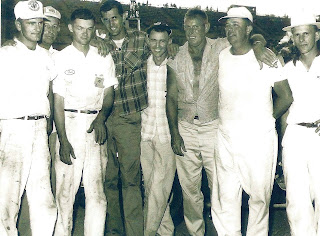
According to Billy “Judge” Sloan, a mechanic who got his start assisting McDuffie, shown here with his brother, Bobby,(right) “Most drivers used Ford with the flat-head engine in those days. Drivers and their crew were known to go after their rivals with wrenches in hand if they thought they were purposely trying to run their car off the track,” Sloan said. “Pretty much, it was, ‘mess with my car, buddy, and you’re messing with me.”
McDuffie raised a lot of eyebrows when he introduced the Chevy V-6 engine that quickly caught the attention of many of the people in the sport, as well as the fans. With a Chevy that was built by McDuffie, Buzz Sawyer recorded the fastest unofficial time of thirty seconds around the half-mile dirt track at a south Georgia location. People began to sit up and take notice of the dynamic duo from Pulaski County. The quicker McDuffie could build a race car, the harder his brother-in-law, Sawyer, would drive it. It was all about speed—pushing the envelope. With a total purse for the night of $500, drivers took chances around the oval race track, slowing only slightly going into the curves, before opening up again on the straight-a-way.


In those days, young men spent a great deal of their time working on car engines. “We used to drive around the countryside looking for old cars which were no longer in use by the owners,” Sloan said. “We could buy them for very little cash, haul them back to the garage, and begin the overhaul process to convert them into stock car racers. Back then, we purchased parts from auto parts stores or dealerships, unlike today when small town drivers and car owners have to go through specialized businesses to get the necessary parts to build an engine.”
Other drivers and mechanics from this area that followed Sawyer and McDuffie were

Woody Moore, shown with granddaughter who is still racing and winning races at the ripe old age of 75, Claude and Howard King, Joe Johnston, Larry Hood and his brother, Sammy. During those early days of the 40s and 50s when Billy Sawyer was driving the dirt tracks in cars which he and McDuffie built, he worked a full-time job with the Coca Cola Company. It has been said that a funeral didn’t take place without cokes being iced down for the family by Sawyer. Fiery on the track, he had a soft spot for those in mourning. He continued to work for the soft drink manufacturer for years. His brother-in-law, however, had a certain genius for building race cars and with him, it was a passion unmatched by many.
Paul McDuffie left the city by the muddy river for a larger city by the Ocmulgee River—Macon. There he teamed up with an old racing rival, Ross Howard. They continued to build race cars while competing anywhere they found a race to be run. Seemingly never satisfied and always looking for the bigger mountain of race tracks to dominate, McDuffie moved to Atlanta, this time seeking to run with the big boys. He set up a garage and tune-up shop on Howell Mill Road in Atlanta and began to build race cars to compete with the best drivers and mechanics in the country. According to legend, many of those drivers began by running moonshine whiskey through the mountains, outrunning the legal authorities, before turning to stock cars. McDuffie was quoted as saying he got “a tremendous thrill from watching cars, which were built by him, race around the track.”
And build cars he could, as indicated not only by the sportswriters covering the action, but in addition to that, was the frequency his team entered the winner’s circle which his vehicles occupied on many occasions.

During 1958, he teamed up with, and built cars for, Glenn “Fireball” Roberts, a legend during his own time of racing. That year with Roberts driving, the McDuffie-built cars swept to thirteen victories while winning over $40,000 in prize money. The following year, the racing industry was shocked when it was announced that Roberts and McDuffie were splitting up their winning team. At first there was much criticism toward Roberts for leaving the McDuffie team. Later, it came out that Roberts was informed by McDuffie that he did not think his 1957 cars could compete in the races of 1959, therefore he informed Roberts he would be able to do better with newer cars. As it turned out, McDuffie was able to find someone later to sponsor him and buy two cars for him to race. There seemed to be a rift between the old racing partners, but they both sat down in Daytona, and McDuffie explained what had happened. Later on, the two got together again when Fireball dropped Pontiac to drive McDuffie's Chevrolet.
In 1960, the mechanical genius, Paul McDuffie experienced his greatest feat by winning the very first “World 600” race in Charlotte, North Carolina, a victory that garnered him a purse of $28,000. The Hawkinsville native was becoming recognized as the best racing mechanic in the sport with a tremendous future in front of him. Sadly, it all came to an end later that year in Darlington, South Carolina when two cars tangled in front of the pit, one crashing over the retaining wall killing McDuffie and two others. Hawkinsville and the entire racing world mourned the loss of the mechanical genius from middle Georgia.