


 One morning, I stopped in for a visit at Larry Hedden’s barbershop. In my mind, I was immediately taken into another place and time, both fictional, and known to most of us as Floyd’s Barbershop in Mayberry.
Hedden was sitting in one barber’s chair, the other was occupied by Ernest Mashburn.
 The only other person in the shop was John Coley, also sitting, but in a regular chair. It may as well have been Floyd, Gomer and Barney passing the time away. There was no urgency to the situation. I got the feeling that world problems had been discussed, if not totally solved. I was greeted amicably, offered a trim, but not a shave, or to take a chair and join the conversation. The shoe shine stand, once an integral part of the barbershop now stands vacant. “Do you even offer shaves anymore?” inquired Mashburn.
“No!” said Hedden. “No one asks for a shave anymore.”
 According to Google on the Internet, at one time there were 8000 barbers in the state of Iowa, however there are less than half that number of licensed barbers in the mid-western state today. Up until World War II, the shave was the main stay of barbershops, that is until the safety and electric razor took over. In the early 1950’s, short hair cuts such as the butch and the flat tops became popular, causing the barber trade to flourish.
In an earlier period of time, the old phrase, “Shave and a hair cut, two bits” became a favorite saying, and later after the war one could get a hair cut for 25c and a shave for 10c. When Elvis Presley became famous, sporting longer locks, the barbers really began to suffer for a lack of business. This was followed by the much longer hair style of the Beatles and others of the invasion of the British style of music, causing fewer barbershops, and a lot less barbers staying in the business.
Haircuts began to soar to a few dollars, and shaves only slightly less. Shops began to close, however in the city by the Ocmulgee River, one could still find a choice of barbershops and barbers, even during the turbulent sixties of hippies and long hair.
Some of the names synonymous with barbering through the years in Hawkinsville have been Southerland, Smith, Horne, Owen and Rewis. Mister Owen cut hair in the country on nhis farm. His son, Greg Owen, an antique collector has restored his father's barber shop as a sall mu
 seum.
seum.For the longevity of barbering however, one name stood out more than any other. Her name is Elizabeth “Lizzie” Roland, four-time widowed barber, who lived to nearly a hundred-years-old. She was known as Mrs. Evans when she took over the barbershop from her deceased husband, Jim. Next, she married Terrell Wammock who cut hair part-time and repaired bicycles in the rear of the barbershop. Sometime after his death, she married Van Ellis from nearby Cochran. Widowed once more, the diminutive barber married another resident from Cochran named J. T. Roland. When one lives to become nearly a centenarian, one can expect to outlive most mates.
The very resilient barber began cutting hair in the late 1930’s and cut consecutively until she was 93, when she retired. In 1965, she was joined by a young barber who cut hair in her shop for five years. That barber was Larry Hedden.

There were three Southerland brothers who cut hair in Hawkinsville at the same time, although not always in the same barbershop. Charlie, also known as “Big Charlie,” his brother, J. B. known better as “Bud,” and Willie. After the death of his brothers, Bud Southerland and Dewey Horne went into business together, later electing to go their separate ways. Horne set up shop near, what today is known as the 341 Bypass next door to his home. Southerland stayed in the downtown section of Hawkinsville. That business, today, is Hedden’s Barbershop.The very resilient barber began cutting hair in the late 1930’s and cut consecutively until she was 93, when she retired. In 1965, she was joined by a young barber who cut hair in her shop for five years. That barber was Larry Hedden.
At one time, there were two barbers who were cousins, Sidney Smith and J. M. Smith. Each had their own shops, and each employed Southerlands in their business. Charlie and his brother, Willie worked for J. M. Smith, and Bud worked for Sidney Smith.
“One of the most asked questions about barbering,” said Hedden, “is where did the barber’s pole originate?”

To understand the answer to this question, one has to go back into the history of barbering. Again, according to the web site, Google, during the Middle Ages, if you were in need of surgery, you would require a trip to a barber-surgeon. Doctors were expensive and many did not practice surgery because it was regarded as a menial task. Self-help methods were not an option due to the scarcity of sharp tools.
Barber-surgeons used razors, not just to perform operations, but also to cut hair and shave beards. they also extracted teeth, lanced boils, set fractures and let blood. Unlike doctors, barber-surgeons usually had no medical training, and they dealt only with external problems. In 1540, the Company of Barber-Surgeons was created in an attempt to make training and treatment standard.
 Barber-surgeons' shops were usually in the center of towns and attracted customers by displaying a red and white striped pole outside their shop. The colors stood for blood and bandages; these poles can still be found outside some barbershops today. In those days, if the city authorities allowed them to do so, some barbers would display a basin of blood outside to signify bloodletting.
Barber-surgeons continued to practice until the mid-18th century. In 1745 in London the Company of Surgeons was set up, and barbers were excluded; in 1800 it became the Royal College of Surgeons. However, many barbers retained the red and white pole outside their shops and continued to practice simple operations.
“Today,” said Hedden, “I only give a good hair cut when they sit in my chair.”


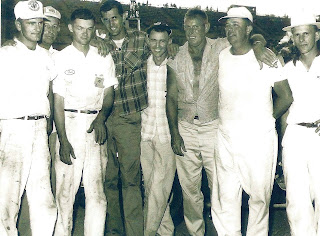
 The competition was fierce in every race, yet there were no injuries. One car, driven by Ed Tyndell of Unadilla, blew a front tire causing his vehicle to veer out of control. Momentarily, he was shaken up, but returned shortly to finish the race. Sawyer, a gritty and determined competitor took first place in one race and except for a poor start, could have taken another victory later on into the


 Early the next morning, thunder awakened me with a start. Rubbing my eyes, I could see the pink numbers of the clock informing me that it was only ten minutes past four, nine o’clock in our hometown of Hawkinsville. Sheila lay quietly beside me, her breathing barely discernible. Again and again the thunder roared, but seemingly too much in rhythm. Without rising, I suddenly realized the thunder boomers were not accompanied by bright flashes of lightning. It was only then, I realized the “thunder” was not from the heavens above; rather it was the incessant pounding of the Pacific surf against the sea wall, only a few feet from the condominium where we were sleeping.

 Another day should be planned to visit world famous Hana.

.jpg) Pulaski County has its own story which deals with total commitment of a family. Fred and Ida Sanders Hogg, who had a family of eight children, six sons and two daughters, made such a commitment during the historic war. This is an attempt to tell the story of a family who has a military history that begs to be told. The boys and their sisters were raised in a Christian home on the Chicken Road. Fred Hogg spent most of his life repairing Chevrolet automobiles and Ida stayed home to issue out the discipline to those who merited it. There must have been a considerable amount of discipline, considering that many boys were around to find fault with each other. Raymond Hogg, one of the surviving members of the family, lives in Florida where he has enjoyed the success of a business entrepreneur for many years. “We were like a lot of boys,” he said, “fighting amongst ourselves. My younger brother, Tommy and I fought mostly about who would get to ride our bicycle.”
Pulaski County has its own story which deals with total commitment of a family. Fred and Ida Sanders Hogg, who had a family of eight children, six sons and two daughters, made such a commitment during the historic war. This is an attempt to tell the story of a family who has a military history that begs to be told. The boys and their sisters were raised in a Christian home on the Chicken Road. Fred Hogg spent most of his life repairing Chevrolet automobiles and Ida stayed home to issue out the discipline to those who merited it. There must have been a considerable amount of discipline, considering that many boys were around to find fault with each other. Raymond Hogg, one of the surviving members of the family, lives in Florida where he has enjoyed the success of a business entrepreneur for many years. “We were like a lot of boys,” he said, “fighting amongst ourselves. My younger brother, Tommy and I fought mostly about who would get to ride our bicycle.” 


