Wednesday, July 18, 2012

Thursday Night Hoedown


Hosting the evening of the Thursday Night Hoedown are owners,
Tom and Sandy Grinstead.

   By Sam Crenshaw

As we strolled into the restaurant, I was reminded of a time in our past when the lovely singer, Sue Ellen McGraw and a guy named Guy would be singing the old country western song, "Hit the road Jack and don't you come back no more, no more, no more, no more. Hit the road Jack and don'tcha come back no more.

Guy would reply, "Well woman oh woman dont'cha treat me so mean, you're the meanest old woman I've ever seen...." and before long they would be singing the theme song for Uncle Ned Stribling's band, "Come on along with me tonight, come on along with me.  Come on along to Hawkinsville tonight to the Hayloft Jamboree."

And they came, and they came, and they kept coming to the old National Guard Armory with a brown bag surprise in one hand and a woman with the other hand.  Whoeee! Squeeze the lemon, now one more time! Grab the lady behind you and promenade on down the line.

Literally, cold chills or goose bumps accompany my memories of that great venue of Uncle Ned and his group.  Too many years have passed for me to remember everyone and last names and so forth, but Uncle Ned played the piano, Pee Wee played the steel guitar, a guy named Al sang some country songs and Bill always sang the slow dance songs, sounding a lot like Jim Reeves, when he could remember the words, and the men dancers held on tight and swung that ladies around.  Sue Ellen and Guy sang lively duets.

My old classmate at HHS, Jerry Mullis and his wife, Donna
invited us to meet them for the Thursday Night Hoedown.
Now granted that was a long time ago, and a lot of water has flowed under the bridge since then, but based on the crowd of music lovers and dancers recently showing up to enjoy the music and dancing, it brings to mind the huge crowds that used to follow Uncle Ned's Hayloft Jamboree around.

The huge crowd for the Thursday Night Hoedown
 was partly made up from folks from other towns. 
The above group came from Fort Valley.
As we walked in, we were keeping an eye out for a former resident of Hawkinsville and classmate of mine, Jerry Mullis and his wife, Donna.  They had called to invite us to come and see the crowd that is attracted to the shindig. Jerry owns a seafood market in Macon, something he has done for a number of years. Through his years of business, his activity in church and other associations, he has become acquainted with a musician named Jimmy Tucker who has a group named the Tucker Boys, and a group of followers of his music shows.  That group showed up that night with three carloads including around fifteen or so revelers from the Macon area.  Seated at a table not too far from them was another group from Warner Robins totaling some ten or twelve people. Others from towns all around middle Georgia filled in and made for a good crowd.

Providing the music and the entertainment were Hawkinsville favorites,
Chris Sercer and sister, Donna.
Now that night, they were in for a real treat as local Post person/musician, Chris Sercer and her sister, the quick-witted Donna, were on hand to offer the great music and laughter which took them to Nashville, Tennessee a few years ago where they brushed with fame and fortune.  Sercer who sings enough like the late, great Patsy Cline to pass for her twin can put on a rollicking performance for a crowd singing the huge hits like "Crazy", "Walking After Midnight", and many more.
Retired Postal worker, Benny Huett was joined by his wife at the
Thursday night hoedown.
Music and dancing have always been part of Hawkinsville's history from the aforementioned square dancing, some small clubs like Horne's Drive Inn to the Jaycees sponsorship of street dancing and games which used to be an annual treat where  Jackson Street could be roped off for the entire town to enjoy. I think about my late cousin, Sammie Ruth Crenshaw who enjoyed dancing and told me of the great times she had when she was a young and pretty teenaged girl. 
Part of the local group enjoyed the dancing and the music.

Louise Richardson, formerly my high school
classmate enjoys most Thursday night dances.
Me?  I was just a young boy who loved watching the guys spin the wheel for the mouse or mice to run into, but oh what a great time the city folks and country folks had with all of the effort that was put into the big show!  All of the people who used to enjoy street dances, square dances, club dancing and the like show their pleasure when they attend the laugh-filled good times and great music.

I didn't see Thomas Herrington that night, but my understanding is when he feels good, no one enjoys shaking a leg like he does. Old Cypress Knee has always been one of this writer's favorite subjects regardless of his outlandish pranks he pulled as a youngster, or his episodic trips to different places, some remembered, some not, and the wonderful way that he learned so many musical instruments including the piano which sets in his place of business.  Some of my other classmates, Louise and Frances who attend the "Thursday Night Hoedown" tell me that he can still enjoy dancing with the ladies.

The crowd enjoyed the Buffet Dinner held prior to the entertainment.
My wife Sheila who attended the get-to-gather grabbed me for a quick dance which had to be as miserable for her as it was to me since I'm still trying to recover from knee replacement surgery, however it was a good evening of fun and frolicking―great dancing and good music.

Monday, November 14, 2011

Corporal Tony Mullis Part Two

On April 17, 1990, a baby boy named Tony Mullis was born to “Big” Tony and Cozetta
Mullis in the Houston County Hospital. His father works in Pool Construction and his mother is a career active member of the United States Air Force. Perhaps, that had some early influence on the young boy who decided a long time ago that he wanted to serve in the military.
Just slightly before Tony was born, a pretty baby girl, Jeanie, was born to Cliff
and Christie Bush in Hawkinsville. It was a strange fate of destiny which led these two babies to meet and later to become married. Both of them wereattending school together in Hawkinsville but seemed to be too busy with otherthings to become very interested in each other.
Tony was a good student, but he was most fond of his science teacher,Hillary Barker under whom he made an “A”.
In high school, Tony, always a good athlete—something that would come in handy for him during his tour in the military—played on the Hawkinsville Red Devil baseball team and was a good infielder for a team which included childhood friends, Dustin Noles, “John-John Offenburg and Jason Lunsford, but the desire to enlist in a branch of the military kept creeping back into his mind.
Still not dating each other Tony and Jeanie were aware of each other, but seemingly
not interested enough to ask for a date.
And then, graduation time came and fate stepped in to have the two
seniors placed side by side for the ceremony.
It was convenient enough to make it comfortable for them to overcome
their shyness and talk to each other through commencement rehearsals. Sitting next to each other made it easier to
relate during those planning days for graduation. Those practice exercises made it easier to
“get acquainted.” So much so that the couple became friendly; and later even friendlier.
The friendship was enough for them to begin dating each other exclusively.
Tony worked for his father while in high school and immediately after graduation
until his dream to join the Marines began to take shape in his thinking.
As with many young boys, strength comes in numbers and one of his pals from school was also in the thinking stages of joining with him, however he later changed his mind and opted to go to college. Tony was adamant about joining the military so he could get the opportunity to travel and see more of the world outside of the confines of his hometown. Indeed, he believed the military was his ticket to do just that.
In addition, Tony was eleven when the attack on America on September 11, 2001 took place, and he remembers being scared that his mother might be killed or wounded as a result of the war on terror in her position in the Air Force, not an unusual concern for a boy of that age.
Nevertheless, in December, 2009, Tony Mullis enlisted in the Marines and headed for Camp
Lejeune, North Carolina, home for the largest number of Marines in the world—over 40,000—where he would enter Boot Camp. He was in the first three months of his new life, a Marine enlisted man. “I knew it would be a difficult time,” he said, “but I was surprised about all of the
yelling that went on during the shaping of new recruits into fight-
ing Marines.”
The job description for Combat Engineers includes construct, alter, repair, and maintain buildings and structures; lift and move heavy objects and equipment by setting up, bracing, and utilizing rigging devices and equipment; and perform various duties incidental to the use of demolitions in construction projects and destruction of objects. Personnel assigned this MOS are taught carpentry and other construction skills as well as demolitions, specialized demolitions for urban breaching and land mine warfare.
It wasn’t until after Boot Camp which lasted three months,
followed by a month’s intensive training, and finally another three month’s training at a place called Courthouse Bay where he was trained to be a Combat Engineer with emphasis in Mobility, Counter Mobility, and Survivability. It was there that Mullis learned what was expected of him in locating hidden IEDs and getting help in defusing or destroying them. It was also there after Boot Camp that he married his sweetheart, Jeanie Bush, the girl he really got to know during his high school graduation.
What did the future hold for the Marine from the city by the muddy river?
More than 1.65 million U.S. service members have been deployed to Afghanistan and Iraq since September 11, 2001. More than 35,000 service members have been physically wounded.
When asked what his expectations of his first deployment? Mullis answered, “I felt that I had been trained properly, but until I started utilizing all of the preparation
training, I didn’t know what my expectations would result in during actual
combat.”
Cpl. Tony Mullis received his orders in October, 2010 about ten months after his enlistment. His orders were to the Middle East in Afghanistan. “I had good training but only after getting it into action first hand did I realize what my job was and how to do it,” Mullis said. “Older and more experienced Marines looked after the new guys to make sure they handled the job correctly, as I did likewise for new guys after having been out front myself.”
Tony Mullis’s first deployment lasted from October 2010 until early March, 2011, and he learned his job well and rose to a promotion to Corporal in the Marine Corp. He returned back to Camp Lejeune in March and looked forward to seeing his new wife who was now expecting their first child. The return to America and the visit with his bride was enjoyable, but far too short. It also was a sad time for Jeanie and members of both families to see his quick return to the battlefield in Afghanistan.
His group pulled out on March 21, 2011, and little did anyone expect they would see him again so quickly—April 6 when he was tragically wounded by the very thing he was out there to locate for destruction.


Saturday, November 12, 2011

The Corporal Tony Mullis Story


The day, April 6, started out like all other days for Cpl. Tony Mullis and his fellow Marines, with the exception that Tony had learned the day before on the fifth that he had become a father to a
son.

The due date for his wife, Jeanie was to be April 6, but little Cason Mullis had a different idea and came quickly into his new world, a few hours before. His father, a Marine Combat Engineer found out around eight o’clock that night which was around noon in Hawkinsville. He was able to call his wife on her cell phone and talk to her right away. In addition, he got another treat as she held the phone near her newborn son so Tony was able to hear him making baby noises. Admittedly, Mullis said it was one of the greatest thrills of his life to hear his son across thousands of miles.
It was a happy thought for Tony to sleep on that night. The group of Marines fell out for chow prior to going on their duty assignment of locating and destroying IEDs which means Improvised Explosive Devices, the number one weapon of choice of the Afghans and Iraqi forces. Primarily, it is made up of unexploded bombs or newly created ones and then hidden from sight in well traveled places by the Marine Forces.
On April 6 in 2011, Cpl. Mullis was on point—meaning the first of his group—marching determinedly ahead to try to locate IEDs which had been planted in the dirt of the roads or huts they were inspecting based on intelligence they had received showing an extra amount of activity around the huts which were usually occupied by farmers.
To get a better understanding of the geography, one must realize that Afghanistan huts may be located within mud walls which may be as large as a city block. The huts, themselves, usually are small, about one or two rooms, and the land is shared with other hut owners for the purpose of raising crops and animals. The walls are their way of saying to others, including our military forces, to keep away and leave them alone.

But on this day, the troops had information that there had been an unusual amount of suspicious activity and it required some on site investigation. As a Marine Combat Engineer, Tony Mullis took the first moves toward the mud walls and quickly, but carefully scaled it to begin his probing search. In his hand was a long probe which he used to try to safely locate a hidden IED. “So far so good,” Mullis thought as he walked stealthily around the hut and inside, finding nothing. Just before walking out to give the thumbs up sign to his comrades, something caught his eye on the dirt floor near a window. He walked slowly inspecting the ground carefully before he both felt and heard a click. Before, he could move, the IED exploded throwing him upward to the ceiling and just as quickly casting him down to the floor. Instantly he knew he was injured, but not to what extent. He looked at his right arm and noticed it had been ripped open with shrapnel, leaving bone and flesh exposed from his elbow to his hand. The next sound was his voice yelling as loud as he could, “I’m hit! I’m hit!” It was then he took a quick look to inventory himself. His legs felt like they were in a hole, unattached. He could see that his left leg was ripped away and his right leg was broken and turned to a right angle from his body.
By this time he was located by one of his colleagues who looked at the extent of his injuries and uttered an expletive. “They have called a bird (helicopter) and it shouldn’t be long.
Struggling to keep himself calm, Mullis asked, “How long before the bird gets here?”
“About five minutes!” he was told. He was also told that an officer was injured on the other side of the mud wall, but it may only be a concussion.

Outside of the wall, his Marine leaders affixed a bomb in the mud wall to blow an opening which would be large enough for them to carry Mullis out to the helicopter. Only moments later, they had him aboard the chopper and began treatment immediately. Morphine was administered for pain and blood transfusions started right away. The helicopter would head to Camp Leatherneck, a small Marine base used for stabilizing the wounded Marines, before sending him to Germany to a hospital within hours. Altogether, he had taken approximately a dozen pints of blood already. In today’s warfare, the speed of getting treatment right away has increased the chances for survival and lessened the Killed in Action fighters. For one thing, the Marines are all equipped with a card in the pocket of their shoulder which shows not only what type of blood as was the case of the old dog tags, but a chip which tells about the entire medical history of the fallen Marine, which increases his chance of survival tremendously.
In Germany for only a day or so, Mullis asked an on duty Contract Nurse if she could send his wife an e-mail requesting a picture of his newly born son. She went off duty before she could complete the request, but Tony asked a second nurse for the favor, and she was successful in retrieving a picture of his son. After a day or so, he was flown to Bethesda Naval Air Station Hospital where he would begin numerous surgeries over the next few months.

Meanwhile, Jeanie, her mother, and some others accompanied her to Maryland where she was able to see her wounded husband. It was the miracle of modern warfare care-giving which literally carried Cpl. Tony Mullis from battlefield injury to his family in four days.
Please read Part Two


Thursday, June 9, 2011

Story of Buddy Glue

We flew as a crew on the Super Constellations shown below with the 7th Fleet as Early Warning Squadron during 1957 through 1960.

One only has to experience my topic today regarding Buddy Glue to understand what I mean.
I recently read a story in my March 2011 Readers Digest magazine entitled, “The Men He Left Behind” which was about a man named Carlos Santos-Silva and his Band of Brothers which he served with in Afghanistan. He was their Sergeant First Class and according to the article, he was a hands-on leader. Each platoon is led by an officer and he has a platoon sergeant who serves as his right-hand man in administration and logistics. Santos served as the platoon leader, and could have stayed behind at the outpost while his men patrolled, however he never did that. He truly led his men and was there with them in all they did. On that morning in March he occupied the front passenger seat in a hulking, mine-resistant truck driving down a dirt road which ran along a vineyard when they were about to cross a small bridge. It happened there! They hit a buried IED, improvised explosive device, which by now we know is the worst enemy of all of our brave warriors serving in the terrible war zone of the Middle East.
According to the article, the bomb was huge and it left the armored truck turned on its side with a scorched bottom and the rear tires blown completely away. Three miles away, another sergeant leading a foot patrol heard the explosion and indicated that “Our guys just hit an IED!” Sound according to the article takes about fifteen seconds to travel that far. The radio said “Four were responsive and one was unresponsive to the blast.” The next thing that happened was a group of soldiers weighted down with fifty pounds of armor, ammunition, radios and weapons running, without regard to their own safety, toward the blast location. Arriving panting, sweating with leg muscles and lungs on fire they looked at the deep crater in the dirt road. One of the men, Sergeant Dale Knollinger approached another man at the site and was told that Sergeant Santos was gone. He stood in the middle of the road and cried. That is Buddy Glue!
Great Friend, Jim Thomas, left, on Guam and in Hawaii over fifty years ago.


Having never experienced combat in my three plus years in the Navy, I had nothing to directly approach that same feeling, however I do know there is a Buddy Glue when you go from home into a military setting where other guys become your family. I still share e-mails and an occasional phone call with some men I served with over fifty years ago in the Navy. It is difficult to have that day to day companionship; however there will always be feelings and memories that will linger about that special part of our lives.
How strong was the glue of their friendship? One man had the opportunity to receive a promotion in grade and pay, but turned it down to stay with Sergeant Santos. It’s difficult to explain unless you have experienced it.
Please pray for our brave warriors.

Saturday, April 23, 2011

Our World Changed in the Sixties


As the fabulous fifties eased out of our lives and etched themselves into our memories of the past, a much different decade rolled into our existence. It would bring with it music from the Mother country headed straight for fame and fortune. It would become known as Beatle mania. It would change an entire generation of music as we had known it. They were only the beginning salvo fired by the British invasion.
The sixties would bring us Camelot—gold and shiny—and snatch it away early in its infancy. Assassination would take away not only a President and a leader of the Civil Rights movement, but in addition a presidential candidate. Sooner rather than later, we would begin to wonder who would be the next target.
There would be new pioneers exploring a different horizon during the sixties, and before the decade was over, the United States who trailed the Soviet Republic through much of the earlier space exploration would break into the lead in spectacular fashion.


Two Americans, Neil Armstrong and Edwin “Buzz” Aldrin would become the first men ever to set foot on the surface of the moon. It would be the last time the U.S. would ever trail the communist nation in space exploration.
In 1960, the election for the nation’s highest office would be a hotly contested race between two men in their forties. Richard Nixon, a veteran of WWII, and the Vice-president to Dwight David “Ike” Eisenhower during his eight years as president, was the Republican nominee and another veteran of WWII, Senator John Kennedy would represent the Democratic Party.
The nation would watch debates on live television between the two candidates for the first time in history. When the dust settled, Kennedy won by a narrow margin in the Electoral College and an even smaller margin in the popular vote.
In Hawkinsville and Pulaski County, many people who went to school with this writer during the fifties were completing either a tour in the military or graduating from college. Some returned to their roots in the city by the muddy river while others plowed a path in other cities and other states. Those of us who returned home found that a part of the innocence we left behind had disappeared. Oh, it wasn’t totally sophisticated by any means, but the joyous, carefree days of our youth would never be the same again.

For one thing, many of our friends had “jumped the broom” and begun the life of adulthood. No longer were our “running around” friends available to go with us around and around the Dario-O. It was indeed a group of younger kids doing some of those same things which we had done throughout our youth. Mostly we were shut out through an age difference. No longer were we the boys who wore football jackets that were treasured by girls, rather a group of much younger boys had the desired garment. Little girls when we left home had become big girls and were not interested in old men in their early twenties.
Some of the innocence lingered in small towns versus what went on in bigger cities and university towns. At a time during our youth, we really had very little to tempt us in the ways of vice. The most we could find to do wrong was smoking on the sly or to go with a group of boys to the rear of Horne’s Drive-in to sneak a beer—which really tasted yuk, although we would not admit that it didn’t taste good.
The new youth for whatever the reasons had begun to experiment with a weed called marijuana. It would not be the last thing they would try in seeking new thrills. Their counterparts in colleges around the nation were getting into more and more drugs and though it would take some time before it reached small towns, it would nevertheless eventually come to tempt and ruin many lives in rural communities including our own.
Two of the most defining events during the 1960s that would re-shape the nation would be the Civil Rights movement and America’s full involvement in the Vietnam War. The Civil Rights movement came about as a result of attaining no results from the ruling of the U.S. Supreme Court in May, 1954. In Brown versus The Board of Education of Topeka, the court ruled that racial segregation in public schools is a violation of the 14th Amendment. It reversed an 1896 ruling that permitted racial segregation if the facilities which were provided each race were of equal quality.
Generally, the birth of the Civil Rights movement is attributed to a diminutive Negro woman named Rosa Parks who refused to move to the rear of a public bus in December, 1955 in Montgomery, Alabama. She was subsequently arrested and placed in jail for her action. A massive protest and boycott of the Montgomery public transportation was led by a Negro minister named Martin Luther King and eventually, the Blacks won the right to sit anywhere on a public bus. Though this would be the first skirmish of the movement, by no means would it be the last.
The nation would see Freedom buses set ablaze, marchers pummeled, beaten and kicked. Dogs were set upon protestors, churches were blown up with dynamite, one of which killed four innocent children, and a leader of the movement, Medgar Evers was murdered in cold blood — shot in the back while leaving his car—gunned down in his own driveway. They would see the disappearance of three young men during the participation of voter registration. Eventually, they would be found dead, buried in a dam on a farm. White law enforcement officers in the state of Mississippi were eventually found guilty of complicity in their deaths.
After many times of having been jailed, Martin Luther King, the foremost leader of the Civil Rights movement would be shot dead as he stood on the balcony of a motel—the Lorraine where he was staying—while he was leading a protest in Memphis, Tennessee. His legacy lived on and the Blacks of America finally were granted equality.

Friday, March 11, 2011

I Want to Say This, Go Braves!


Last Fall in September, the Atlanta Braves were in first place in the National League Eastern Division. Hopes ran high that the Braves were going to once again bring a title home to the “Big A.”
All the time the ever dangerous Philadelphia Phillies were beginning to cut the Braves lead and it began to look like it would be a run to the last day of the season when the two teams would meet and they it happened. Greed! Mighty Fox Network began to fuss at Dish Network and demanded an increase from the satellite company. Dish bucked and the Braves fans were the real losers.
With three games left in Atlanta between the two teams, supposedly to be televised by Fox Sports Network or Sports South and brought into my home on Dish Network, the screen told it all when it said the broadcast would not be made until there was a settlement. October first through October third my television sat idle as I bemoaned the greed of the millionaires. To express my anger is an understatement!
I have been a baseball fan for over sixty years, and I’ve been an Atlanta Braves fan since they moved south from Milwaukee in the mid 1960s. I’ve seen good, bad and ugly teams in the city where the Atlanta Crackers minor league team formerly played. I’ve even seen great teams which went on to win fourteen straight Division titles and one World Series in 1995. There is no question of my fandom nor my loyalty. Hope springs eternal every March when the teams of the majors move to Florida for spring training.
When I was a young boy around ten, I invented my own baseball game, using a cardboard box, ice cream sticks and buttons borrowed from my mothers sewing materials. If I had known it could have been done, I would have been able to patent the game and today people might be comparing my wealth with that of Bill Gates, however suffice I to say the game gave me endless joy as I played for hours at a time entertaining myself and keeping statistics of how the games came out.


To say that I was irritated at the greed of the billionaires who owned those two companies would not be sufficient. I was livid! I began searching other ways to watch the games, all to no avail. I could only strike back at them by cutting them off at the knees—reducing their service in my home to the barest level of channels—and hoping many others would do the same. My Dish bill went down to nearly half what it had previously been, and I hoped other Braves fans were doing likewise. Amazingly enough, we suffered only a small amount as we returned to watching programs like the Andy Griffith Show and All in the Family. Shoot! Remember some of my previous Cotton Patch columns where we used to get only one fuzzy station out of Macon when we first purchased this old house forty years ago, and if I wanted to try for one out of Albany, I had to take a pipe wrench outside the house and try to turn my antenna enough to get a very fuzzy program. Mess with me!
Well, without my support, the Braves lost all three games in October to the Phillies, but made the playoffs as a Wild Card team losing to eventual World Series winner San Francisco Giants. However, as I said previously Spring Training has begun and I am thinking again about baseball. First on my agenda was to contact Dish Network to find out if the argument had been settled with Fox. Yes, I was told and if I wanted to increase my coverage to include the stations which broadcast the Braves games, it would only cost me five dollars. “I’ll think about it,” I said as I secretly planned on calling a rival satellite company to see what their cost and coverage would amount to. Ain’t free enterprise wonderful?
So what will happen to the Braves this year? I think their chances of competing for the Division title against the Phillies are very good. It should be said that the Phillies made a couple of moves which give them four pitchers who may be unequaled in the majors this season, however our Braves have a pretty good staff as well. We’ll throw out Comeback player of the year, Tim Hudson, veteran Derek Lowe who has steadily improved each year of his contract, third year pitcher Tommy Hanson, and Jair Jurgenns who went down last year with some unexpected injuries. A couple of Rookies, Mike Minor and Brandon Beachy will compete for the fifth spot on the pitching roster.
Our home team acquired a home run hitting Dan Uggla from Florida over the winter and Chipper Jones is trying for a comeback after being injured at the end of last season. Last year’s all-round player, Martin Prado will move to the outfield and the minor league player Freddie Freeman will move into the lineup as first baseman to add hitting and fielding support to a team which was led last year by runner-up Rookie of the Year, Jason Heyward and perennial All-Star catcher Brian McCann in the power department.
The Atlanta Braves already are looking to be improved over last year’s team which won 91 games while finishing second to the Phillies in the Eastern Division.

I would be remiss if I didn’t mention that future Hall of Fame Manager, Bobby Cox hung up his uniform and retired with over 2000 wins in his career. He has managed the Braves for a long time, including every major league game future Hall of Fame player, Chipper Jones has been in the lineup. Not to worry, his longtime coach, Fredi Gonzalez was hired over the winter and I think he will step right in and continue the winning ways for the Braves organization.
We’ll have to put our murder shows—Dateline and 48 Hours—Andy and Barney and All in the Family on the back burner by the time the end of March when the call will once again go out to “Play Ball!”
Go Braves!

Thursday, December 9, 2010

Scott Echols Tragic Accident


In a fleeting moment a couple of weeks ago in Blakely, Georgia, Scott Echols of Bleckley County was involved in a traffic accident that could have snuffed out his life. As it is, he will be hospitalized for “months, not weeks” in an attempt to recover.
How tenuous life’s journey can be! On Sunday evening November 7th, Echols, a 51-year-old Broker in the Alaskan Fishing Industry, started out for Enterprise, Alabama to check on his uncle who was in the hospital in serious condition. His journey took him through a route to Blakely where he was t-boned in his small automobile by a much larger SUV leaving him in critical condition—fighting for his life—in the blink of an eye.
Scott, the husband of Cherie Thompson Echols and the father of a daughter, Morgan who is a sophomore at Middle Georgia College, and a son, Jacob who placed seventh in the state in pole vaulting on the track team and also plays on the Bleckley Royals football team as a place-kicker, finds himself in the biggest battle of his life.
After Echols graduated from college, he traveled to Alaska to become a commercial fisherman in the rough seas of the 49th state. He fell in love twice—once with the fishing industry—and secondly with Cherie Thompson of Cochran. As Scott moved around the world fishing on boats, his new wife followed him and they eventually had two additions to their family.
After years away from home in Cochran, the couple agreed to move back and settle down where they grew up, giving their two children the hometown stability they felt they needed, and as a result of the Internet, Scott could continue his brokerage of the Alaskan Fishing Industry.
Echols father-in-law, Ron Thompson said one of the EMT professionals told him that “Mister Echols was as strong as an ox,” as they worked with him to get him onto the stretcher and immobilize his arm for the purpose of giving him IV fluids. “He was striving hard to free himself from their grip as he clung to the desire to survive,” one of the medical specialists said.
As they began the journey from Blakely to Dothan, Alabama which was the nearest Trauma hospital, someone called his wife in Cochran to inform her that Scott had been in an accident and they were now en route to Dothan.
Immediately, Cherie Echols made plans to drive to lower Alabama, uncertain of the directions or the seriousness of her husband’s injuries. Stopped in her tracks by her father, Mrs. Echols was told that he would drive her to Dothan, an area with which he was familiar. When they were an hour from their destination, Echols received a cell call informing her that they were going to move her husband to Birmingham where there was a larger and better equipped Trauma unit. Nevertheless they continued onward and arrived before the move was made.
Upon the action to move Scott to Birmingham, the family members continued their trek northward through Alabama.
In serious accidents of life or death, there are many quick decisions to make—giving doctors and medical teams permission to operate and further examine the injured party, locating a place where the family can stay, and determining visiting hours, etc.—and Cherie Echols had plenty to make. Through the worst of times cool heads and blessings sometime take over. A member of a Birmingham church arrived after a couple of days and offered Echols the use of a church-owned apartment for up to three months. Doctors continued working on her husband to save his life. Scott has suffered both lungs collapsing, ribs broken, legs broken, a ruptured spleen and many more serious injuries that will take a long time from which to recover.
Of course, one of the most serious problems the family is facing is tremendous medical and doctor bills and a very long time with no family income while Scott is no longer able to work. Cherie is in nursing school and has no income. A fund has been opened at the State Bank in Cochran, 112 Beech Street, Cochran, GA 31014 and it is entitled the Scott Echols Fund for those who can and will donate funds to help a worthy family in time of great need. Donations can be made in your name so the family can acknowledge their thanks to you, or donations may be made anonymously.
Contact Crenshaw at samsam3125@yahoo.com

Saturday, October 16, 2010

Lance Cpl. Christopher Blake Rodgers


Almost everyone can remember where they were and what they were doing on September 11, 2001, the day of the worst attack on American soil in history which took over 3000 lives. The day almost immediately became known as 9/11 which remains ingrained in the minds of Americans everywhere.
Blake Rodgers of Griffin, Georgia was ten years old (shown above) when he witnessed the giant planes crashing into the twin towers of the World Trade Center in New York City. He was so shocked that he cried. He also told his parents that he wanted to become a Marine, and he wanted to help fight against those who were involved in killing so many of his fellow Americans.
His father is Chris Rodgers, his mother is Jane, and his younger sister is Emily. Blake has a connection to the city by the muddy river. Many people will remember Mary Nell Barlow who, along with her brother Gene were raised by their aunt and uncle, Julia and Reeves Gilbert. Still others will remember C. W. “Chuck” Barlow who was raised by William “Bud” Barlow and who recently passed away after a long illness.
Perhaps not so well remembered would be their sister, Velma Barlow who was raised by her aunt and uncle, Estelle and G. W. Beeland in Griffin. The reason this family of children, all of whom are this writer’s first cousins, were raised by uncles and aunts was because their mother and father had separated and the father, Vance Barlow, (shown below right) at the age of 39 was later tragically killed in an electrical accident. The mother had disappeared. Three families who raised the children were aunts and uncles, children of William Right and Prezzie Wynne Barlow of Hartford, on the eastern side of the Ocmulgee River. The Barlow family—large, (shown below left) but no larger than many others in the turn of the Twentieth Century era—had twelve children of which ten survived to adulthood.
Velma Barlow Pierce shown above with her husband Paul are grandparents to Blake Rodgers.
As a child, Blake enjoyed building—anything his youthful imagination could conjure up — houses, buildings, ships, and planes. Blake built them with his Lego set. As he grew older, Blake played baseball on several youth league teams. He enjoyed camping, hunting, fishing, paintball, airsoft, shooting and just hanging out with his friends. He was a highly accomplished artist. Blake was also an authority on aircraft, a passion he indulged through reading, building models, drawing aircraft, visiting airports and attending air shows. It wouldn’t have been difficult to imagine him as a fighter pilot or aeronautical engineer.
On 9/11 all that changed! Blake, the 11-year-old, witnessed with horror and disbelief as airplanes were used as weapons to attack his people and his country. It was on that day Blake decided to be a Marine. Having made that decision, even at such an early age, Blake set out to make himself as knowledgeable about being a Marine as he had done with his beloved aircraft. He read, studied and played video game simulations in an attempt to glean information about weapons, strategy and tactics. He learned to shoot and became extremely proficient at it.
After graduation, Blake (shown here with sister, Emily and Mother) enlisted in the Marine Corps in July. In October 2008, he left home for the first time, en route to The Marine Recruit Depot at Parris Island, S.C., and Marine boot camp. Almost immediately, Blake began to excel, culminating with his selection as his recruit platoon’s distinguished high scoring marksman. As one might imagine, in a branch of the military service wherein all Marines are riflemen first and anything else secondarily, earning the Expert Rifleman Badge is an accomplishment truly worthy of praise. Blake wore his with pride. (Blake Rodgers achieved his goal of becoming a Marine)

His acknowledged marksmanship prowess notwithstanding, no one, no matter how fit, how smart or how gifted with a rifle, ever becomes a United States Marine without first having endured a 54 hour marathon of fatigue, sleep deprivation and limited rations designed to push recruits far beyond their personal limits of performance and thereby expose the true “don’t quit, never give up” attitude and Marine spirit within them. Coupled with the running, forced road marches with heavy packs, constant barrage of simulated attacks, field problem solving and team and leadership building exercises are put to the test. It is there, in those seemingly unending hours of hell on earth, that the recruit proves, not so much to the instructors, but much more importantly, to himself, that he is worthy of being a United States Marine. That vital self affirmation was memorialized in the small, desert camouflage New Testament that Blake carried during boot camp; where the quote, “I will never give up, never give in, take it as it comes and grow stronger,” was written in his hand, on its inside front cover. The meaning and the rewards that phrase portended were forever etched into Blake’s mind when, on a cold Saturday morning in January 2009, he heard from his drill instructor the words, “Congratulations, Marine.”
At that moment in time, Christopher Blake Rodgers had achieved his goal, a goal he had harbored and single-mindedly pursued since that fateful day in 2001 — he had become a United States Marine.
Upon graduating from boot camp on January 16, 2009, with the rank of private first class, Blake moved on to the School of Infantry at Camp Geiger, N.C. While there, he was recognized for his use of novel strategies and tactics in leading his assault team in overtaking a position held by members of the instructor cadre. Upon being overrun by Blake’s team, the surprised and dumbfounded instructors asked where he had learned those techniques. Blake’s reply was that he had devised them during his days of playing paintball and “Navy Squeals,” a takeoff on the movie “Navy SEALS,” with his cousins and friends. So impressed with his methods were the staff that Blake’s techniques are now taught to other
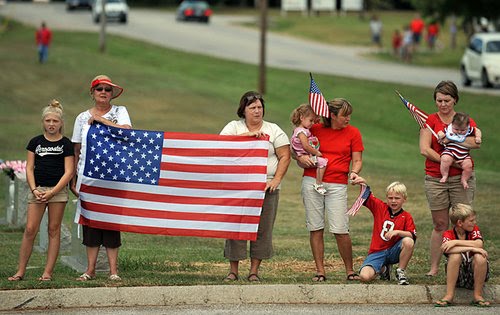
Marines as part of the curriculum there. (shown below left are some of the thousands who lined the highways to show their gratitude to the fallen Marine, and shown right are the Marine Pall Bearers)


Marine Lance Cpl. Christopher Blake Rodgers died doing what he loved, for those he loved, with those he loved as brothers at his side, in harm’s way, in a land far away. We can never and will never forget his sacrifice.
Blake Rodgers was killed in action Wednesday September 1, 2010 in the Helmand Providence of Afghanistan, hardly a worthy place to claim the life of such a warrior. Helmand is one of the 34 provinces of Afghanistan.
(Below is the presentation of the United States Flag to Blake's Mother who is accompanied by his sister and father)

It is in the southwest of the country. Helmand is the world's largest opium-producing region, responsible for 42% of the world's total production. He was laid to rest Saturday, Sept. 11, 2010, a date chosen to commemorate that seminal moment in history wherein the course of our nation was forever changed in the blink of an eye, a date that so affected an eleven-year-old boy from Griffin, Ga., that he dedicated his young life to service and to righting that horrific wrong, a date that irrevocably altered his life, our lives and through his sacrifice, the lives of people he never knew.
Semper Fi Marine

Saturday, August 28, 2010

Picture Show Thompson's Theater


During my childhood, my friends and I would walk south on Jackson Street on our way to the magical display on the wide expanse of the green lawn in front of the home of Picture Show Thompson. It was indeed magical to our youthful eyes. It was the most decorated yard we had ever seen.
Unlike today when everyone seems to be able to decorate their homes and yards for the Christmas Season, people were either too poor or lacked the imagination to turn their home and property into fantasy. After we got there, the equivalent of four blocks from where we lived, we stood in awe at the manger scene, the wise men, the shepherds abiding their flocks and even Jolly Saint Nick in his sleigh following the reindeer—minus the now famous Rudolph who had not yet been created. I remember it passionately, wishing the characters could move around and greet all of us. In reality, they were cut-outs from wood—painted and decorated to celebrate the season—but all the wishing would not turn them into a live scene.
Just when we thought it could get no better, Picture Show Thompson did the same thing by bringing all the Joel Chandler Harris characters from “Song of the South” a wonderful movie about Brer Rabbit, Brer Bear, Brer Fox and especially our beloved Uncle Remus to his lawn—probably in the Spring—while promoting the great movie. If he had never done anything other than to thrill the residents of the city by the muddy river with his wonderful lawn decorations, he would have put himself in the minds and hearts of many young people. But that wasn’t all he did for us. Through his movies, we learned how to go on adventures with the Durango Kid, Roy Rogers, Lash LaRue and of course he taught us to laugh at the likes of the funny sidekicks, Smiley Burnette, Gabby Hayes and Fuzzy St. John. He brought us a weekly villain to teach us how to cheer for the good guys—cowboys with white hats—each week and to learn right from wrong by showing us that the bad guys might get away with evil deeds, for awhile, but not in the end.

Who was this man we called Picture Show Thompson and where did he come from to enter into our lives with his magic?
He was born on the cusp of the Twentieth Century, 1896, in a small village in Alabama named Detroit. He was educated in Amory, Mississippi and took his first job in Memphis, Tennessee as a messenger boy for Western Union before relocating to Dallas, Texas where he and the movie business got acquainted. He became an usher, and later a doorman, for the Old Mill Theater. That was in 1917-18.
Afterwards, he entered the selling business and his product was theater advertising, which he did for several years.
Later, he began to sell films for Fox Corporation in Atlanta.
His son-in-law, Guerry Boone Stribling, now deceased, who married Thompson’s first-born daughter, Sandra, remembers some of the humorous stories about the man who brought the merriment into our lives through the talking pictures. “During those days of selling films,” Stribling said, “Pappy, as our children lovingly called him, told of an incident which showed his ability to create a reason for people to purchase films from him. He drove a truck in those days loaded with films. He parked in front of the local theater, got out and put up a display telling about a film he had concerning a man named Floyd Collins who had become national news when he got stuck and lost in a cave in Kentucky. After putting up the display, Pappy walked down the street to have a cup of coffee. He told me when he returned there were at least a hundred people standing around the display clamoring for a way to see the film. The theater owner came out to him and pulled him aside to make a deal to get the film. He was a hustler and a showman. He really enjoyed dressing up in a cowboy outfit.”

His daughter, Sandra believes that he was a frustrated actor who would have loved being a movie star—probably a cowboy actor.
In 1931, he made a life altering move when he purchased a small theater in the tiny town of Hawkinsville. The theater was named the Princess, and his career kicked into overdrive when he later purchased the Princess in Eastman, the Princess in Baxley and the Auditorium Theater in Cochran. With the growing company, he decided to incorporate and named the business, All-Amusement, Inc. The early years—1931-1933 were not all business as he met and married a beauty named Ernestine Milam. The couple had their first child, Sandra Faith Thompson in 1934 and the next year he merged his business with a Columbus man named Roy E. Martin and the name of the corporation changed to Martin and Thompson Theaters, Inc. with Thompson serving as President in 1935.
The man we called Picture Show Thompson had the unlikely name of John Herman Thompson, but was known by associates and friends as Tommy Thompson. Although he was heavily involved in his chosen profession as Vice president of the Georgia Southeastern Theater Owners Association, Thompson never was shy about participating in civic affairs of his new community, having served for two years as president of the Pulaski County Chamber of Commerce, and as Vice-president of the Pulaski County Fair Association. Perhaps it was his high energy level that got him appointed as the Chairman of the one hundred year Centennial Celebration of Hawkinsville garnering headlines in the Atlanta Journal Constitution
Newspaper for the successful festivities.
As a credit to his business sense and/or his desire to keep his adopted hometown in the loop with movies, he apparently took a deep breath and moved ahead with a plan after a tragic fire demolished the beloved Princess Theater in downtown Hawkinsville in the 1940s. This writer remembers seeing the theater after it was destroyed and wondering what our lives would be like without Roy and Dale, Gene Autry, Charles Starrett, Alan “Rocky” Lane, Lash LaRue and Sunset Carson.
Picture Show Thompson, the man we had come to depend on for our Saturday entertainment did not miss a beat. He immediately arranged for some temporary building changes to the old City Auditorium—now known as the Old Opera House—and suddenly we had movies again until the re-building of the new theater complete with a new name, The Thompson Theater became part of our lives.
In another move, during the 1950s, we were introduced to a new medium by Picture Show Thompson. Movies underneath the stars—the M&T Drive-in Theater! I remember clearly the opening movie being Ma & Pa Kettle, a hilarious couple with a large family, a bossy mother and a sedentary father who all made us laugh.
At the Thompson, he had on stage such cowboys as Lash LaRue and the bad guy, Jack O’Shea, Tex Ritter who sat on stage singing his hit song, “Rye Whiskey.”

Dan Duryea who played Black Bart in the film with the same name came to our town and paraded throughout the city in Thompson’s Cadillac while many of us chased the car on our bicycles.
But in the early 1950s even in the heyday of movies, a new phenomenon was lurking in the background that would change everything for the dynamic showman who brought many movie stars to our small community. It was something called television, but the great movie showman was not worried. He even rejected the offer from his partner Roy Martin to get into the television business, thinking it would not last.
“Pappy said that three things would save his movie business,” his son-in-law said. “They were Bill Haley’s movie “Rock Around the Clock,” Elvis Presley and popcorn. He really didn’t believe TV would amount to anything.”
Today, the vacant shells of old theaters sit empty in small towns across America, a sad reminder of a great past and the great owners of local entertainment. The newspaper which prints this article stands now in the same location of the old Princess and later the Thomson Theater. A cemetery is now located in the spot where Ma & Pa Kettle made us laugh.
As the famous movie star, Bob Hope would say, “Thanks for the Memories.” Picture Show Thompson will always be in our wonderful thoughts of what used to be.