Monday, January 25, 2010

Barber Shops, Now and Then

One morning, I stopped in for a visit at Larry Hedden’s barbershop. In my mind, I was immediately taken into another place and time, both fictional, and known to most of us as Floyd’s Barbershop in Mayberry.
Hedden was sitting in one barber’s chair, the other was occupied by Ernest Mashburn.
The only other person in the shop was John Coley, also sitting, but in a regular chair. It may as well have been Floyd, Gomer and Barney passing the time away. There was no urgency to the situation. I got the feeling that world problems had been discussed, if not totally solved. I was greeted amicably, offered a trim, but not a shave, or to take a chair and join the conversation. The shoe shine stand, once an integral part of the barbershop now stands vacant. “Do you even offer shaves anymore?” inquired Mashburn.
“No!” said Hedden. “No one asks for a shave anymore.” According to Google on the Internet, at one time there were 8000 barbers in the state of Iowa, however there are less than half that number of licensed barbers in the mid-western state today. Up until World War II, the shave was the main stay of barbershops, that is until the safety and electric razor took over. In the early 1950’s, short hair cuts such as the butch and the flat tops became popular, causing the barber trade to flourish.
In an earlier period of time, the old phrase, “Shave and a hair cut, two bits” became a favorite saying, and later after the war one could get a hair cut for 25c and a shave for 10c. When Elvis Presley became famous, sporting longer locks, the barbers really began to suffer for a lack of business. This was followed by the much longer hair style of the Beatles and others of the invasion of the British style of music, causing fewer barbershops, and a lot less barbers staying in the business.
Haircuts began to soar to a few dollars, and shaves only slightly less. Shops began to close, however in the city by the Ocmulgee River, one could still find a choice of barbershops and barbers, even during the turbulent sixties of hippies and long hair.
Some of the names synonymous with barbering through the years in Hawkinsville have been Southerland, Smith, Horne, Owen and Rewis. Mister Owen cut hair in the country on nhis farm. His son, Greg Owen, an antique collector has restored his father's barber shop as a sall museum.


For the longevity of barbering however, one name stood out more than any other. Her name is Elizabeth “Lizzie” Roland, four-time widowed barber, who lived to nearly a hundred-years-old. She was known as Mrs. Evans when she took over the barbershop from her deceased husband, Jim. Next, she married Terrell Wammock who cut hair part-time and repaired bicycles in the rear of the barbershop. Sometime after his death, she married Van Ellis from nearby Cochran. Widowed once more, the diminutive barber married another resident from Cochran named J. T. Roland. When one lives to become nearly a centenarian, one can expect to outlive most mates.
The very resilient barber began cutting hair in the late 1930’s and cut consecutively until she was 93, when she retired. In 1965, she was joined by a young barber who cut hair in her shop for five years. That barber was Larry Hedden.
There were three Southerland brothers who cut hair in Hawkinsville at the same time, although not always in the same barbershop. Charlie, also known as “Big Charlie,” his brother, J. B. known better as “Bud,” and Willie. After the death of his brothers, Bud Southerland and Dewey Horne went into business together, later electing to go their separate ways. Horne set up shop near, what today is known as the 341 Bypass next door to his home. Southerland stayed in the downtown section of Hawkinsville. That business, today, is Hedden’s Barbershop.
At one time, there were two barbers who were cousins, Sidney Smith and J. M. Smith. Each had their own shops, and each employed Southerlands in their business. Charlie and his brother, Willie worked for J. M. Smith, and Bud worked for Sidney Smith.
“One of the most asked questions about barbering,” said Hedden, “is where did the barber’s pole originate?”


To understand the answer to this question, one has to go back into the history of barbering. Again, according to the web site, Google, during the Middle Ages, if you were in need of surgery, you would require a trip to a barber-surgeon. Doctors were expensive and many did not practice surgery because it was regarded as a menial task. Self-help methods were not an option due to the scarcity of sharp tools.
Barber-surgeons used razors, not just to perform operations, but also to cut hair and shave beards. they also extracted teeth, lanced boils, set fractures and let blood. Unlike doctors, barber-surgeons usually had no medical training, and they dealt only with external problems. In 1540, the Company of Barber-Surgeons was created in an attempt to make training and treatment standard.
Barber-surgeons' shops were usually in the center of towns and attracted customers by displaying a red and white striped pole outside their shop. The colors stood for blood and bandages; these poles can still be found outside some barbershops today. In those days, if the city authorities allowed them to do so, some barbers would display a basin of blood outside to signify bloodletting.
Barber-surgeons continued to practice until the mid-18th century. In 1745 in London the Company of Surgeons was set up, and barbers were excluded; in 1800 it became the Royal College of Surgeons. However, many barbers retained the red and white pole outside their shops and continued to practice simple operations.
“Today,” said Hedden, “I only give a good hair cut when they sit in my chair.”

Friday, January 8, 2010

Before NASCAR

Half-Mile Dirt Tracks

NOTE: For those interested in where we stayed on Maui CLICK here for details www.mauiyes.com and get ready for a vacation in paradise


VA-ROOM! VA-ROOM! Pow, Pow, Pop! VA-ROOM! VA-ROOM! The flat-head engines of the 1936 Fords were sounding off as they warmed up for the race. In the late 1940s, a group of men got together and converted the famous horse racing track in Hawkinsville to a dirt track for stock car racing. It was a forerunner to what is known today as NASCAR, a billion dollar industry. In today’s version of NASCAR, names such as Jeff Gordon, Mark Martin, Bobby LaBonte, and Dale Ernhardt, Junior are some of the darlings of racing fans around the country.
Long before them came names like Jessie James Taylor, Nero Stepto, Wild Bill Bennett, Ross Howard, and the twin package from Hawkinsville, Billy “Buzz” Sawyer and one of the best racing mechanics to ever turn a wrench, Paul McDuffie shown below.

The night when stock car racing began in Hawkinsville at the old harness racing track, it attracted a near capacity crowd. According to the records, there were fifteen drivers participating in the races that night with a total of sixty laps around the half-mile dirt track.


The competition was fierce in every race, yet there were no injuries. One car, driven by Ed Tyndell of Unadilla, blew a front tire causing his vehicle to veer out of control. Momentarily, he was shaken up, but returned shortly to finish the race. Sawyer, a gritty and determined competitor took first place in one race and except for a poor start, could have taken another victory later on into the evening.
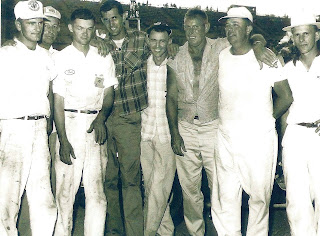
According to Billy “Judge” Sloan, a mechanic who got his start assisting McDuffie, shown here with his brother, Bobby,(right) “Most drivers used Ford with the flat-head engine in those days. Drivers and their crew were known to go after their rivals with wrenches in hand if they thought they were purposely trying to run their car off the track,” Sloan said. “Pretty much, it was, ‘mess with my car, buddy, and you’re messing with me.”
McDuffie raised a lot of eyebrows when he introduced the Chevy V-6 engine that quickly caught the attention of many of the people in the sport, as well as the fans. With a Chevy that was built by McDuffie, Buzz Sawyer recorded the fastest unofficial time of thirty seconds around the half-mile dirt track at a south Georgia location. People began to sit up and take notice of the dynamic duo from Pulaski County. The quicker McDuffie could build a race car, the harder his brother-in-law, Sawyer, would drive it. It was all about speed—pushing the envelope. With a total purse for the night of $500, drivers took chances around the oval race track, slowing only slightly going into the curves, before opening up again on the straight-a-way.


In those days, young men spent a great deal of their time working on car engines. “We used to drive around the countryside looking for old cars which were no longer in use by the owners,” Sloan said. “We could buy them for very little cash, haul them back to the garage, and begin the overhaul process to convert them into stock car racers. Back then, we purchased parts from auto parts stores or dealerships, unlike today when small town drivers and car owners have to go through specialized businesses to get the necessary parts to build an engine.”
Other drivers and mechanics from this area that followed Sawyer and McDuffie were

Woody Moore, shown with granddaughter who is still racing and winning races at the ripe old age of 75, Claude and Howard King, Joe Johnston, Larry Hood and his brother, Sammy. During those early days of the 40s and 50s when Billy Sawyer was driving the dirt tracks in cars which he and McDuffie built, he worked a full-time job with the Coca Cola Company. It has been said that a funeral didn’t take place without cokes being iced down for the family by Sawyer. Fiery on the track, he had a soft spot for those in mourning. He continued to work for the soft drink manufacturer for years. His brother-in-law, however, had a certain genius for building race cars and with him, it was a passion unmatched by many.
Paul McDuffie left the city by the muddy river for a larger city by the Ocmulgee River—Macon. There he teamed up with an old racing rival, Ross Howard. They continued to build race cars while competing anywhere they found a race to be run. Seemingly never satisfied and always looking for the bigger mountain of race tracks to dominate, McDuffie moved to Atlanta, this time seeking to run with the big boys. He set up a garage and tune-up shop on Howell Mill Road in Atlanta and began to build race cars to compete with the best drivers and mechanics in the country. According to legend, many of those drivers began by running moonshine whiskey through the mountains, outrunning the legal authorities, before turning to stock cars. McDuffie was quoted as saying he got “a tremendous thrill from watching cars, which were built by him, race around the track.”
And build cars he could, as indicated not only by the sportswriters covering the action, but in addition to that, was the frequency his team entered the winner’s circle which his vehicles occupied on many occasions.

During 1958, he teamed up with, and built cars for, Glenn “Fireball” Roberts, a legend during his own time of racing. That year with Roberts driving, the McDuffie-built cars swept to thirteen victories while winning over $40,000 in prize money. The following year, the racing industry was shocked when it was announced that Roberts and McDuffie were splitting up their winning team. At first there was much criticism toward Roberts for leaving the McDuffie team. Later, it came out that Roberts was informed by McDuffie that he did not think his 1957 cars could compete in the races of 1959, therefore he informed Roberts he would be able to do better with newer cars. As it turned out, McDuffie was able to find someone later to sponsor him and buy two cars for him to race. There seemed to be a rift between the old racing partners, but they both sat down in Daytona, and McDuffie explained what had happened. Later on, the two got together again when Fireball dropped Pontiac to drive McDuffie's Chevrolet.
In 1960, the mechanical genius, Paul McDuffie experienced his greatest feat by winning the very first “World 600” race in Charlotte, North Carolina, a victory that garnered him a purse of $28,000. The Hawkinsville native was becoming recognized as the best racing mechanic in the sport with a tremendous future in front of him. Sadly, it all came to an end later that year in Darlington, South Carolina when two cars tangled in front of the pit, one crashing over the retaining wall killing McDuffie and two others. Hawkinsville and the entire racing world mourned the loss of the mechanical genius from middle Georgia.

Wednesday, December 23, 2009

Our Tropical Vacation

Through my admiration for such determination, a strong desire on my part to tell their story, and their kind generosity, we set into motion plans to visit them in Maui.
We had been in the air close to five hours. After having left Atlanta around mid-morning; we were in hot pursuit of the sun, chasing it on its westerly journey. We caught and passed it before our arrival in Los Angeles. However with a four hour layover in that airport, the chase for the sun was on again, this time across the great Pacific Ocean.
Nearly five hours later, daylight clung precariously over the tropical isle. We were just under half an hour from “paradise.” As the pilot began his descent, the lights of the beautiful island winked at the load of travel weary passengers, beckoning us to come on down. Awaiting our arrival was Norman and Margie Kay with the traditional Hawaiian lei to drape around our necks, followed by a kiss of welcome.

Early the next morning, thunder awakened me with a start. Rubbing my eyes, I could see the pink numbers of the clock informing me that it was only ten minutes past four, nine o’clock in our hometown of Hawkinsville. Sheila lay quietly beside me, her breathing barely discernible. Again and again the thunder roared, but seemingly too much in rhythm. Without rising, I suddenly realized the thunder boomers were not accompanied by bright flashes of lightning. It was only then, I realized the “thunder” was not from the heavens above; rather it was the incessant pounding of the Pacific surf against the sea wall, only a few feet from the condominium where we were sleeping.
Gazing from the building’s glass enclosed front, which faced the ocean, two coconut palm trees stood guard over the small lush-green lawn. Bent slightly, twisted with time, and perhaps even groaning a little against the constant onslaught of the unforgiving trade winds, they, nonetheless, stood strong, never yielding their hallowed ground. With each gust of wind the long palm fronds danced in the breeze, alternating between waving and merely hanging, dripping the salty mist of the sea.
A short time later, on the lanai, Sheila and I dined on fresh pineapple, papaya, bananas in cream, soft scrambled eggs and toast; though our island hosts deny any complicity, there was a beautiful “end to end” rainbow which appeared during our meal as if to emphasize that we were indeed in “paradise.”
Our dream vacation began with an invitation one day that fall from Norm and Margie in Hawkinsville. As we enjoyed lunch with them, Margie said. “We want y’all to come visit us in Maui,”

“That’s very nice.” I replied. “Maybe we will someday.”
“Sheila and I will work out all the details,” she said.
That was in September, and quite frankly, I had not thought about it any further until the bitter cold weather hit Hawkinsville in January. Sheila said, “We have a letter from Margie Kay in Maui.”
In the letter was information about their island paradise, and an invitation to visit them and to be their guest in their ocean front condo. The rest, as they say, is history.
The next day after our arrival, our wonderful hosts began to show us their magical paradise with a trip to the Maui Ocean Center, the Hawaiian Aquarium. Already mesmerized by the humpback whales swimming and jumping off shore, within plain sight of our ocean front condo, we were about to enter into a journey of discovery through the extraordinary underwater world that lies beyond Hawaii’s surf-ringed shores.

All of the marine life including some of the most unusual fish, coral and plants was a replica of what can be found around Hawaii. This writer saw fish which were previously seen by me only on computer screensavers. All kinds of fish from something named the Orangeband Surgeonfish, eels, and Milletseed Butterflyfish to huge Brown Stingray and Tiger Sharks. One could easily spend several hours in one of the world’s greatest aquariums. Our hosts were more than patient with us as we oooh’d and ahhh’d our way through the fantastic experience. It is a “must see” experience for anyone going to Maui on a vacation.
On our second day in paradise, we did a very American thing with a very Hawaiian flavor. We attended the College All Star Hula Bowl football game which was an all day affair that wound up full of excitement. Arriving at the stadium around noon, we stood in line for a short while talking to visitors from Nebraska and once the gates opened we did our version of a “tailgate party” while watching a pre-game show that was only the beginning of more to come. Having gotten away Saturday morning without turning on the television, we were saddened at the announcement of the crash of the Columbia space shuttle which claimed the lives of all those aboard. The officials of the Hula Bowl arranged for a “missing man” fly over by some helicopters to pay tribute to the astronauts.
Once the teams took the field, the excitement of seeing so many talented players on one field got the crowd into it. Unlike mainland contests where the teams would be named North and South, they instead were named KAI which means sea and AINA which means land. This was very appropriate since that is what one sees in Maui. Land and sea! Both teams were coached by big-time mentors. Larry Coker of the Miami Hurricanes guided the KAI team while Mack Brown, of the Texas Longhorns coached the AINA team. Although it was led throughout most of the game by the KIA team, the last five minutes of the last quarter was extremely exciting with the AINA team capturing two on side kickoffs which they quickly converted to touchdowns. With only a few seconds left in the game they managed a field goal to win the game. During the half-time show a special treat was presented by over 300 cheerleaders doing a hula dance followed by a stirring rendition of Lee Greenwood singing his famous tune of “God Bless the USA” Following the game was a sensational fireworks display. Thus far only two days of our vacation had taken place.

Another day should be planned to visit world famous Hana.
The two-lane Hana Highway parallels the tortuous lava-formed coastline, passing through forests and over streams and past waterfalls. After more than six hundred hard turns and fifty-six single-lane bridges, palm-bordered ranches, pineapple and sugarcane fields, red- and black-sand beaches, jungle and volcanic craters all converge at Hana. It is some of the most beautiful land on earth and well worth the effort to see it.
Not far from there are the gravesides of Charles Lindbergh, the famous aviator and his friend, Sam Pryor, author of “All God’s Creatures.” Pryor and his wife and Lindbergh are all three buried in a small church cemetery.


Whether one goes to Maui to see the sights, shows or swim and surf in the ocean, it certainly is a wonderful experience and I can highly recommend it to one and all. We will be forever grateful to our friends, Norman and Margie Kay for their wonderful hospitality while we learned of their paradise.

Wednesday, December 2, 2009

Beyond the Call of Duty

More Stories of Hawkinsville, Georgia

During World War Two, over 16,000,000 Americans served in the gallant effort to defeat the military might of Germany, Italy and Japan. Today, there are approximately 3,000,000 veterans of the conflict left. Estimates put the current loss, through death, at somewhere between 1,200 to 1,500 per day. Add to that number 400,000 who died in WWII, and the math shows us that over 13 and a half million of our WWII veterans are deceased.
History was made when city boys, and farm boys alike, volunteered—from all walks of life—after the sneak attack on Pearl Harbor by the Imperial Japanese war machine. The Americans of that era have been called the Greatest Generation, and history has labeled them heroes, although most shun the label, claiming instead they were just doing a job which needed doing.
When Adolph Hitler began his quest to rule Europe, and when the Empire of the Rising Sun bombed Pearl Harbor, practically destroying the United States Navy, they had no idea what kind of men they would ultimately have to face before the end of what became World War II.
Tom Brokaw, longtime anchor news journalist for NBC Television, penned a best-selling book called The Greatest Generation in which he eloquently told the stories of so many veterans, those who survived as well as those who did not return home. The only problem with the book was that it could not tell all of the stories of WWII.
One of the great stories of the war involved five brothers. They were among the most famous of all the fighting men of World War II. The five Sullivan brothers, serving together in the Pacific, symbolized America's commitment to winning the war. But their deaths caused outrage and forced the military to change long standing policies that allowed a family to lose an entire generation at once. On Friday, November 13, 1942, a Japanese torpedo struck the USS Juneau at Guadalcanal.
Steven Spielberg depicted a story about WWII in the movie, Saving Private Ryan, in which three brothers were killed in battle and a group of soldiers were dispatched into battle to find the last living brother. Their mission was to bring him back alive.
Pulaski County has its own story which deals with total commitment of a family. Fred and Ida Sanders Hogg, who had a family of eight children, six sons and two daughters, made such a commitment during the historic war. This is an attempt to tell the story of a family who has a military history that begs to be told. The boys and their sisters were raised in a Christian home on the Chicken Road. Fred Hogg spent most of his life repairing Chevrolet automobiles and Ida stayed home to issue out the discipline to those who merited it. There must have been a considerable amount of discipline, considering that many boys were around to find fault with each other. Raymond Hogg, one of the surviving members of the family, lives in Florida where he has enjoyed the success of a business entrepreneur for many years. “We were like a lot of boys,” he said, “fighting amongst ourselves. My younger brother, Tommy and I fought mostly about who would get to ride our bicycle.”

“That is true,” said Tommy. “Raymond always thought he could get the best of me, but I had my share of victories, too.”
The first of the Hogg boys to go into the military was Julian, who actually joined in 1938 before the war began. He was supposed to be discharged in 1941. That all changed when the United States became involved in the war.

Julian Hogg’s term of enlistment in the army was extended until near the end of the war. During his time in the army, he was a Sergeant in the Chemical Warfare Service, having served in campaigns in North Africa, Sicily, and Italy before moving into southern France for what would no doubt be his most dangerous assignment. He was involved in the European theater including the Normandy invasion, an event that ultimately spelled the beginning of the end to Hitler’s madness.
Much like Spielberg’s Saving Private Ryan where there were multiple brothers involved in the European invasion, the Hogg family had another son involved in the Normandy invasion.

Richard Hogg, in a different location from his brother Julian, was also present when the D-Day operation came to fruition. Six months of planning had taken place while enormous forces gathered in southern England. In all, there were 10,000 aircraft, over 4000 landing craft, and 1500 warships under the direction of General Dwight Eisenhower, who was the supreme commander. Throughout the massive invasion and its aftermath, neither of the Hogg brothers suffered an injury.

During WWII, Sergeant Neil Hogg served in the army, based in Alaska, before moving on to the Aleutians.
Perhaps the most traveled of the Hogg brothers was Petty Officer First Class Willie Fred Hogg, a machinist mate in the Seabees. He gained valuable experience building roads, bridges and airstrips throughout the Pacific during the war. After the war’s end, Hogg would spend most of his life working within the field of building and engineering of bridges, roads and oil rigs.
The fifth of the six Hogg brothers to serve in WWII was Raymond who convinced his parents to sign for him to join the navy. He became a member of the submarine forces in 1945 before the war ended. During his substantial amount of sea duty he sailed on top of and underneath the ocean extensively throughout the south Pacific, including Japan and China. Raymond was finally discharged in 1949.
The sixth Hogg brother, Tommy, was only fifteen years old at the conclusion of the great war. His age kept him home during WWII, however when he turned eighteen in 1948, he continued the military tradition of the Hogg family by joining the army under a special program of one year active duty and six years in the reserves. After his discharge in 1949, he returned to the city by the Ocmulgee River where he worked in a cotton warehouse. In the early 1950s something called the Korean conflict began and not only was Tommy called back into the service, but his older brother Willie Fred was activated back into the navy. Both brothers were finally discharged at the end of the Korean War.


In addition to the military service of the six Hogg brothers, their sister, Mary’s husband Earl Walton was also in WWII, and their other sister, Marjorie’s husband, J. T. Wynne served in the National Guard. In the entire family, no one was killed. When asked what he attributed the good fortune of the family, the late Tommy Hogg replied, “I guess Mama and Daddy did a lot of praying.”
The children of Fred and Ida Hogg have shown the true American spirit by serving in the United States military. They have gone beyond the call of duty while serving God, family and country.

Wednesday, November 18, 2009

The Last Service Station in Hawkinsville


The Peter Bogdanovich movie, “The Last Picture Show,” a black and white version of a small Texas town was based on a Larry McMurtry novel. The movie reflected life in the 1960s when theaters began to be replaced by televisions for family entertainment. In the fictitious community, the picture show closed after the owner died.
Life changed in many communities when the local picture shows began to close. In Hawkinsville, the Thompson Theater closed, and only those who recall “Picture Show” Thompson’s business being part of their lives remember that it was once located where the Hawkinsville Dispatch & News expanded addition is today. In many small towns, one can see the skeletal remains of a local picture show.
In another movie, “Back to the Future,” a young man from the 1980s was transferred to the year 1955 via the script and a Delorean automobile. As he walked around an earlier version of his home town, the camera followed a car into a service station for gasoline.

Moments later, a group of four men came out of the garage bay and surrounded the car, checking the oil, washing the windshields, sweeping the inside with whisk brooms and adding air to the tires—all of this in addition to having someone pump gas into the vehicle.
For those of us who grew up in a time when drugs stores had soda fountains and sandwich shops in them, every town had a picture show—now known as cinemas and found only in larger cities or metropolitan areas—grocery stores on every corner, and full-service gasoline stations in abundance. There are no more small grocery stores on every corner, and only a couple left in the county. There are no drugstores with soda fountains to be found. All of these things we no longer have, give us an inherent desire to cling to “The Last Service Station,” aka Woodard’s Service Station, as if we are clinging to a part of our heritage.
In his attempt to name the owners of gas stations throughout his years in Hawkinsville, Ronald Woodard began to sound like he was naming a who’s who of the history of Hawkinsville. Scratching his head, Woodard began to name off those he could recall during his sixty years. “Aaron Sewell, Freeman Bragg, Johnny Anderson, Bud Curry and his uncle, Charlie” Woodard said; “there was Bussey Woods, Leroy Gatlin, Tom Chalker, Aaron Floyd, Pete Butler, and Woodrow Powers who had a Phillips 66 station. There was Sam Clark, Melvin “Bully” McKinney, John Henry Anderson and Ray Hill. There was George Grinstead, Floyd Cobb and Lloyd Mays. I’ve been in the service station business myself since 1982. Those are all that I can remember, however there are probably many more that others can remember.”
According to Duane Woodard, brother of Ronald, “J. J. Sparrow, an Auto Parts Dealer told me once that he had 27 gas stations on his books, and all of them paid in full by the tenth of the month.” Both Woodard brothers have been working in the service station business a good part of their lives. Duane Woodard recalls working for Leroy Gatlin at his station which was located on the corner where PlantersFirst Bank is located today. “He really taught me the meaning of full service. He stressed that by showing them what full meant in full service, the customers would keep coming back to the places where their business was appreciated.”
Before the days of full service stations, some businesses installed gasoline pumps on the side of their buildings by the curb. With the coming age of the automobile, the world of business would begin to change drastically. More people who had previously sold buggies, also known as horse-drawn vehicles began to sell automobiles in those same businesses. With the increase in automobile sales, there was an increase in places to sell gas. America was adapting to traveling in machines that supplied their own power: no horse, no mule, no pedals required. By the end of World War I, gas was generally available on America's busiest streets and at rural crossroads. Then, as Ford's mass production and lowered costs began bringing car ownership within the financial reach of average American households, gas stations emerged as stand-alone businesses.
In their early years, gas stations often consisted of small, unsightly buildings and an unattractive assortment of pumps, and they drew complaints from nearby residents. As a result, major oil companies began to introduce standardized stations. Their distinctive styles were intended to build consumer loyalty by making a corporation's stations readily identifiable to customers, and they allowed the stations to blend more compatibly into their surroundings.
In neighboring Bleckley County, authors, William Purser and Fred Noegle, Jr. published a book entitled “The Auto Gypsies.”
Three residents of Cochran, Fred Noegle, Sr., his wife, Emma, and good friend, Miss Pansy Deese set out in their Model “T” Ford on a journey that would take them all the way across the country to California and back. They departed on that tremendous trip on March 6, 1923. Noegle thought to himself that the trip would be so different from the ones who took those journeys many years ago in covered wagons. In 1923, Henry Ford’s Model “T” was still almost in its infancy, and gasoline locations and repair shops were few and far between. Early dispensing was done in various ways. Filling and measuring depended on the capacity of cans, buckets or drums which were used at first, then on to portable rotary pumps and on to actual gauges. It proved to be a pioneer journey in itself. The book is loaded with pictures of the historic trip as well as their story. Certainly, the trio did not have the advantage of full service stations.
With further increases in the number of cars, some gas stations began to broaden their services into vehicle repair and the selling of tires, batteries and other auto parts and accessories. This trend became a virtual economic necessity for many stations during the hard times of the 1930s, as demand for gasoline dropped. Such changes affected station design. New buildings were made larger so automotive wares could be displayed and they often contained built-in bays for auto repair.
Things were somewhat different in the less populous countryside. Gas was, for the most part, sold at existing general stores, which were frequently located at intersections of rural highways. As pre-auto store buildings were replaced and as new stores were opened, the structures often featured covered drives sheltering gas pumps.
In some places, such as Arkansas, the Historic Preservation Program began a focused effort to identify sites related to the state's automotive history. The aim was to call attention to and preserve such places by having them listed on the National Register of Historic Places. In addition to gas stations, AHPP took note of places such as tourist courts, drive-in eateries and theaters, roadside diners, auto showrooms, and roadside attractions like small amusement parks and miniature golf courses. When we look at the history of our city by the muddy river, most of those things have disappeared or at best are standing as haunting reminders of a time gone by. It is little wonder some cling to The Last Service Station where oil and air are checked and windshields are washed at no extra charge.

Monday, November 9, 2009

Voice Sweeter Than Wine


For people who normally see her working the windows of the Hawkinsville Post Office, most have thoughts like cheerful, pleasant, and efficient postal clerk. When they find out that Chris Sercer is a talented singer, one without fear of performing live on a stage in front of a large audience, they are usually blown away. (Chris Sercer, local Postal Clerk in the Hawkinsville Post Office, continues to chase the original dream, singing alone after the retirement of her parents, brothers and sisters from singing.)
Immediately when Sercer took the stage at the Old Opera House, it was clearly evident that she was no stranger to performing. Much like this writer, those in attendance were dumbfounded at the talent she brought to the stage. Immediately, this writer began to wonder about her background. Where did she come from? Where has she been? Nashville? Memphis? New York? When I heard her sing one of the best renditions of the great love song, “Unchained Melody,” I thought there must be a mystery involved here.
Later, during an exclusive interview with Sercer, I asked her what she did before she worked at the post office, a job she has held for the last four years? She smiled shyly, looking downward, before answering the question with a chuckle. “I helped my husband, Jerry, in his business as a land mover.”
“Huh? What did you do, keep books?”
With a burst of laughter she said, “No! I drove a motor grader, big tractors, and earth movers—just whatever needed to be done.”
“Okay! Let’s start over. Where were you born? Tell me about your childhood, your early life, who you married, and how long have you been involved in singing?”
In talking with Sercer, it becomes clear that she is a person who doesn’t take herself seriously. That is to say, she finds much about her past and present life as having a humorous vein. It is just as clear that she does take her music seriously. Sercer has been singing since she was eleven-years-old.
Born and raised in nearby Pineview, the local Postal Clerk continues to chase that dream of becoming a recognized star singer.
(L-R, In their prime as a country and gospel trio, Chris Sercer and her two sisters, Donna and Celia went further than most groups. They chased a dream all the way to Nashville and back to central Georgia.)
As young girls, she and her two sisters began singing, along with their parents and brothers in a family gospel group known as Southern Cross.
After her parents gave up singing, the three sisters continued, gradually beginning to sing country music under the new name of Papa’s Pride. With a great local following while playing in clubs, fairs and anywhere people wanted to hear good music, the sisters had an urge to take their talent on the road.
The trio embarked on a trip to Nashville, Tennessee in an attempt to become recognized in the country music field. It was an expensive lesson for three young women from small town America.
(Shown above with Chris Sercer is Vince Gill a country music legend.)
Around 1990, they admit to having been naïve when they undertook the trip to country music headquarters. Thinking that others would take them for what they saw themselves—good singers who wanted to record music—they seemed surprised that Nashville was full of young singers who were in search of a contract and a shot at the Grand Old Opry. Tiring of the grind with very little hope as a country trio, Sercer’s sisters, Donna and Celia decided they had had it with the grind of Nashville. The trio suddenly became a solo vocalist, Chris Sercer, who was not ready to give up the dream.
Sercer is the first one to admit that the road to stardom is one that can only be described as a rough and rocky road. “My sisters and I were all married with children,” Sercer said. “They were my best friends and still are, and I could never blame them for deciding not to pursue the dream any further. It is especially difficult if you are on the road and your family is back home. It is a lonely journey.”
After her two sisters decided to give up chasing the dream, Chris, continued to sing at every opportunity. When asked about American Idol—a popular reality television show—Sercer thinks it is a good idea for giving undiscovered talent an opportunity to become known. She has no ill feelings about having lost out in her bid to become a singer in Nashville. (Whispering Bill Anderson poses with our postal clerk.)

“I was represented by a group in Brunswick, Georgia for about a year,” she said. “They thought they could get me some chances in the country music capitol, but eventually they ran short of cash. I did sing once in the Charlie Daniels Roundup Talent Show, but was beaten out by a very talented singer. There is no question that she had the talent to win.”
Through it all, she has no remorse about trying. She said her husband, Jerry Sercer was always her biggest supporter—never wavering—bodyguard, chauffer, and fan. If she wanted to try out for anything, he was always encouraging her to do so. (Chris and her husband, Jerry Sercer have two sons and a granddaughter. Jerry is the owner of his own business as a land mover.)

(Shown in this picture are Chris Sercer and one of her favorite horses, Needle Rey.)
Today, the couple own better than 25 horses, a passion they share. Each year, they look forward to a trip to Oklahoma where they participate as a couple in the rodeo. In addition, Chris begins the festivities by singing the National Anthem. ‘It is a great honor, lots of fun, and something we look forward to doing each year,” she said.
Where does the singer/postal clerk go from here? “Wherever the road takes us,” she said. “Life is good! When the opportunity arises for me to sing, I do it. I always sing from the heart, so much the better if people find my singing enjoyable.”
After watching the energy she brings to the stage along with a voice that Nashville missed out on, there is little doubt among her supporters that she has many fans.

(One of those fans is Little Jimmy Dickens of the Grand Ole Opry.)
“She sings Patsy Cline songs better than Patsy did,” said Julie Stewart, booking agent extraordinaire for the Arts Council.
She has been a lead-in singer for the Hall of Fame country group, Alabama, T. G. Shepherd and others. .”
Off and on she has been chasing her dream for years. She has a CD album of her songs available for purchase. She continues to look for her big break. Until that happens, Chris Sercer will continue singing and working the window at the Post Office.

Saturday, October 31, 2009

Hawkinsville, My Home Town, Another Look

In Hawkinsville, Saturdays were almost like school in a different location. Every store—grocery, furniture, hardware, clothing and drug store—had teens working on Saturdays to fill the void needed for clerks. All the country folks came to town that day, ready to spend their money or charge things until they could pay for them later.
Many stores had benches for the customers to sit and visit a spell. For grocery clerks, that could spell danger when they were carrying groceries out to the cars and trucks for the customers. Conversation and laughter outside on the benches was raucous and snuff and tobacco spit was flying, literally causing the clerks to tap dance their way through the maze.
Betty Jo Hadden worked at Ben Silver’s Clothing store. Little Ernie Mashburn and Tony Anderson were busy dipping ice cream cones at Goode’s Drugs. (On the left below is a picture of Goodes Drugs and Soda Fountain during the 1950s. On the right are four classmates from HHS, L-R, Jill Joiner, Billy Shepherd, Lottye Reynolds, and Sayde Fowler, regulars at the soda fountain.)
The Cabero boys were working at Hawkinsville Fruit & Candy Store, something to do with the fact their father was a working partner in the business. Bo or Hans Mayer could be seen walking around town with a cigar box which doubled as a temporary collection box. ( On a recent trip down memory lane, Bo Mayer, right, and her son, Ronnie, showing a striking resemblance to his late father, Hans Mayer enjoyed a visit at the Steak House Restaurant in Hawkinsville.)

In Massee’s Furniture, some of the outstanding athletes from the Red Devils were moving furniture and appliances from the store to customer’s homes. ( Members of the 1954 and 1953 State Champs at Hawkinsville all had to work on Saturdays in the fabulous fifties. L-R, Melvin Borum, Eddie Dunn and David Nelson.)
Near Massee’s Furniture was a very popular business owned by Eddie and Ruby Dunn. Their sons, Edward and Dennis were bussing the counter and keeping the hamburger-satisfied customers moving. The brothers told this writer that the secret to the delicious hamburgers was a mixture of beef and sausage. Coca Colas in the small bottles were good by themselves. The name of the restaurant was the Green Grill.
Every day, Mother would leave my three brothers and me 35 cents each to buy our lunch in town; there was no lunchroom in those days. A typical lunch hour for me would include a fast run to town when school let out for noon break. My first stop would be the aforementioned Green Grill with an order for two of those great hamburgers and a coke—total cost, two bits. After wolfing those down, I had just enough time to survey the counter in Jones Bakery where the PlantersFirst Bank now is located. My big decision was whether to buy 2 donuts or 2 cinnamon rolls, or one of each. Either of the two would set me back the other dime which Mother left me. My nourishing meal was taken care of, leaving me just enough time to trot at a fast pace back to school.
A couple more grocery stores occupied the other end of Commerce Street and Jackson—Sims and A & P, later to become Lancaster’s and Fowlers. Directly across the street was a clothing store operated by a Jewish man named Jack Robbins. Daddy always bought his felt hats in the United Department Store owned by Mister Robbins, a short, strange-looking man with eyes that were magnified by his need for glasses. He was one of several merchants in town who were Jewish, including Ben and Minnie Silver, Myer and Goldie Freed, Hans and Bo Mayer, Sam Sommers, the pecan man, and Sam Dobkins.
Two of the more enjoyable stores for me, as a child, were the ten cent store owned by Freed and his wife. The name of the business was Crests Five & Dime. Almost directly across the street was a competitor named Wynn’s Ten Cent Store. Oh, the things that a young boy could buy in one of those stores—toy cars and trucks, tops, Yo Yos, cap guns, and kites were among some of the things I have purchased for a nickel or a dime during those years. They must have done very well with the small change stores, because memory serves me that a third five and dime named McConnell’s Ten Cent Store opened later.
There were multiple numbers of stores for many things. Altogether, there were about eight or nine grocery stores, at least three furniture stores, several drug stores, and any kind of gasoline station one chose for a favorite.
(Shown below is Bill Goode one of the owners of the Chevy dealers in the city by the muddy riverduring the 1950s.)
The Chevy dealership was owned by Willie Pate and Bill Goode.
The Oldsmobile dealership was owned by Louie Blount, and the Buick dealership was Glenn and Thomas Herrington.
The Way Brothers had a dealership back then also. They were the Plymouth-Dodge dealers.
(An ardent salesman in nhis time, Sam Way ran a promotion giving away anew Plymouth amd it was won by Mrs. Virginia Cobb.
Today, in stark contrast to so many other bygone dealers, Way Brothers has Ford and Chevy dealerships, fierce competitors for a century.
Someone owned a Hudson dealership, and the last Studebaker I recall was a black, sharp-looking one driven by Judge Sloan. (Below is a picture of Billy Judge Sloan a NASCAR fan still. He owned the last Studebaker after they ceased manufacturing them in America.)
There was no shortage of liquor stores in the city by the muddy river either. It was kind of strange that Hawkinsville was the only town that seemed to be “wet.” Little did it matter though because “bootleggers,” a nickname given to those who sold bonded liquor without a license, could still be found. Some even made moonshine and sold it by the fruit jar.
I had a brother seven years older than me who was “bad to drink” as they said in those days. I took it upon myself to keep tabs on him by following his car on my bicycle and watching where he went.
(Looking very much like my old bike, "Paint," it freed me up to travel many miles with very little restriction.)
Mother didn’t want him to drink, and I loved playing spy for my mother. It almost got me killed once. A local saloon named Marchman’s Beer Joint or something like that was a place he went into on one occasion. Sitting astride my trusty bike, “Paint,” I took up a position where I could peek inside without him seeing me. After seeing him swigging on a bottle of beer, I took off for our house to report in to my mother. The problem happened when Mother challenged him about his whereabouts after he got home. In full denial, my brother said she was mistaken. My mother revealed her source quicker than you can shake a stick. I was ratted out! Immediately, I made a dead run for the front door with him in hot pursuit. I was saved that day by another brother, a non-drinking one, just younger that the one I had spied on. He jumped out of a chair and threatened to ‘bust his head open if he touched me. Whew! I was almost a goner. I decided maybe it wasn’t the best idea to spy on my beer-swizzling brother again.

Batts Drugs had a championship soda fountain in those days, and a would-be Miss America dipping ice cream and making shakes. Although Pansy Lollis was several years older than my buddies and me, we loved to go in and flirt with her. She just laughed at us and tried to keep us away from the comic book section too long.
(bove picture is current owner of Batts Drugstore, Ben Cravey sitting on Santa's lap seeking an early Christmas present. There is no soda fountain today.)